The upshot of all this was the potential for calamity, since millions of GPS receivers are being used by business, military, and consumers for everything from navigation and telecommunications, to finance and network computing. Of course, there shouldn't have been any problem for GPS receivers with updated Y2K/EOW-rollover-compliant firmware.
EOW rollover panic wasn't rampant. No, unlike Y2K, there were no conferences, books, consultants, newsletters, web sites, or CNN talking heads trying to scare you out of a few bucks. Yes, there were scattered reports of frantic bass fishermen who depend on GPS to pinpoint secret fishing holes. As it turned out, there was little need to worry, at least in the U.S. where virtually no rollover-related problems were reported. That wasn't the case in Japan, however, where hundreds of people were confused and inconvenienced, as screens on car-navigation systems went blank or were filled with random characters. At least we know where all the nonEOW-compliant receivers were. In short, GPS EOW rollover came and went rather quietly -- this time around.
|
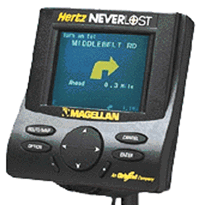
| The "old" Hertz NeverLost GPS. |
I suppose you'd call me a Jonny-come-lately when it comes to this GPS stuff. Gee, even my sister, who is an archeologist, is way ahead of me. Faith has been using GPS for years to identify and locate historical sites in the Negev Desert. (She reports via e-mail, by the way, that she didn't experience any problems with EOW rollover.) In fact, she's on to her second- or third-generation GPS receiver, and insists that they are as necessary to her work as, well, a shovel and a pith helmet.
The extent of my GPS experience, on the other hand, is with Hertz rental cars that have NeverLost In-Car Navigation Systems installed. NeverLost (http://www.hertz.com/serv/us/prod_lost.html), which uses GPS, dead-reckoning, and map-matching technology, is a private-label version of Magellan's proprietary 750NAV vehicle-navigation and driver-information system (http://www.magellangps .com/). More than 50,000 Hertz cars currently come with Magellan hardware and Navigation Technologies (http://www.navtech.com/) databases covering more than 50 U.S. cities.
The Ford Taurus I was driving, for instance, had the entire database for California online. Using a clunky interface, you pressed the cursor pad to select the destination city from a long list of cities, then the street, and finally the address you want to drive to. The system takes a few seconds to compute the best route, then displays on-screen icons and issues audible voice commands to get you going in the right direction. As you approach a required turn, the system alerts you with a beep about a block prior to the actual junction, followed by a voice announcement, such as "Right Turn Ahead." If you miss the turn, you need only press Enter and the system computes a new route for you (and, mercifully, doesn't add the word "...fool.") The Hertz web site and TV commercials are now hawking NeverLost units with a new cursor pad and improved interface -- specifically, a QuickSpell feature that lets you go more directly to a city or street by selecting the first letter of the name, rather than scrolling down a long list. However, the Hertz cars I've recently rented still have units with the old interface.
Okay, I admit that until I actually used one, I thought systems like Hertz's NeverLost GPS were nothing more than marketing gimmicks. But they truly are a valuable application of technology that just happens to be fun. Even with the old NeverLost interface, in-car navigation is relatively easy to use, and certainly much more convenient (and safer) than pulling over to the curb and spreading out a map. And as for the EOW rollover interfering with GPS, don't worry -- it won't come again for another 19 years.
Jonathan Erickson
editor-in-chief
jerickson@ddj.com
Copyright © 1999, Dr. Dobb's Journal