 External Interface Operation Overview
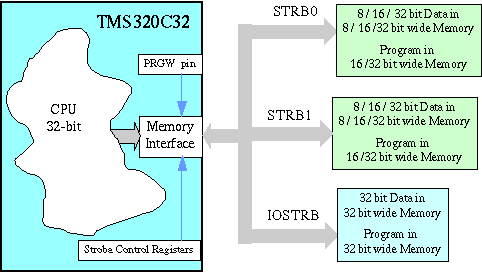
The TMS320C32 memory interface accesses external memory through one 24-bit address bus
and one 32-bit data bus that is shared by three mutually exclusive strobes (STRB0, STRB1,
and IOSTRB). Each strobe's configuration is independent of the physical memory
width and data size, and also independent of the other strobe's configuration.
Depending on the address accessed, the TMS320C32 activates one of these
strobes according to the following Memory Map:
| Address Range |
Active Strobe Signal |
0h - 7FFFFFh
880000h -8FFFFFh |
STRB0 |
87FE00h - 87FFFFh |
On-chip |
810000h - 82FFFFh |
IOSTRB |
90000h - FFFFFFh |
STRB1 |
External Interface Features
TMS320C32's external memory interface includes the following features:
- One external pin, PRGW, configures the external program memory width to 16 or 32
bits.
- Two sets of memory STRBs (STRB0 and STRB1) and one IOSTRB allow
zero glue logic interface to two banks of memory and one bank of external peripherals.
- Separate bus control registers for each STRB control wait state generation, external
memory width, and data type size.
- Each memory STRB (STRB0 and STRB1) handles 8, 16 or 32 bit external data
accesses (reads and writes).
- Each memory STRB (STRB0 and STRB1) handles 8, 16 or 32 bit external memory
widths.
- IOSTRB accesses 32 bit data from 32 bit wide memory. IOSTRB bus cycles are
different than STRB0 and STRB1's bus cycles to accommodates slower I/O
peripherals.
- Multi-processor support through the HOLD and HOLDA signals is valid for
all the STRBs.
|