

What exactly is native signal processing? And how does it complement the Digital Signal Processing Solutions (DSPS) that we offer at Texas Instruments?
The Windows Hardware Engineering Conference (WinHec) last month heard a lot about native signal processing (NSP). Intel Corp., which makes the Pentium microprocessors that are the brains of today's most powerful PCs, said that NSP is the new wave in entry-level multimedia platforms.
According to Intel, the Pentium is so powerful that it can handle many signal processing tasks itself rather than turning them over to digital signal processors (DSPs) like TI's TMS320 family of devices. Signal processing, Intel claims, can be native to the CPU: Hence, the name.
While it is true that the Pentium may perform simple DSP functions, such as audio playback, native signal processing is limited by two extremely powerful forces-the technology and the marketplace.
Start with the technology. The MULTI in "multimedia" demands concurrent execution of various audio, graphics and communications functions. The Pentium can do some of these functions individually, but it cannot perform them concurrently.
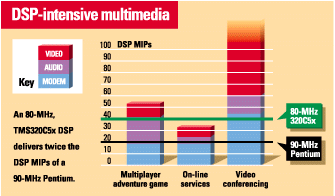
While precise benchmarks are difficult, a Pentium delivers only about one-third to one-fourth the MIPS (Million Instructions Per Second). Because host microprocessors like the Pentium aren't optimized for signal processing, it takes them three instruction cycles to accomplish what a DSP can do in one. This means that a 100-MHz Pentium, running flat out, can do only about as much signal processing as a 30-35 MIPS DSP. TI produces DSPs that deliver 40-50 MIPS today, and that number is growing rapidly.
Of course, the CPU can never devote 100 percent of its processing power to signal processing tasks. If that were to happen, applications would not work.
For some of the more demanding tasks included in multimedia, Intel has tacitly conceded that NSP would need to defer to a DSP to do the job. In video-conferencing, for example, the company recently announced that a digital signal processor, working in tandem with a Pentium chip, is required to implement the international H.320 standard and bring video-conferencing to desktop computers.
TI's TMS320C80 multimedia video processor (MVP), the most powerful DSP device on the market today, is extremely well-suited to H.320 implementation. A 'C80-based videoconferencing PC add-in card can produce sharp video and eliminate most of the blurs and blockiness that we have come to associate with videoconferencing. (See story at right). Beyond technical limitations, key market dynamics also demand Digital Signal Processing Solutions.
Compaq has more than 100 new desktop PC models. IBM builds nearly 50 different PCs for their consumer line with only five different motherboards. Each of these companies achieves the needed flexibility by mixing and matching options for memory, disk drives, modems, sound cards, video and so on. Their expansive market channel strate-gies would not be possible without add-in cards.
It's also true that the term multimedia means different things to different people. To the family using a computer at home, it may mean high-quality sound and graphics for sophisticated video games. Videoconferencing may have little value to that family, but it is at the core of what a lot of businesses mean when they say multimedia. Obviously, these markets require different features, and DSP-based add-in cards remain the most economical way to accommodate these differences.
No single solution can fill the needs of an increasingly diverse PC market. What is needed is a continuum of DSP Solutions. Customers want choices that reach beyond the capabilities of the Pentium. And even as more powerful microprocessors become available, customers' expectations and the signal processing demands of ever improving multimedia devices will grow, too. And TI has the line of DSPs that meets the needs of multimedia platforms as well as many other end equipments.
Bill Gates, chairman of Microsoft Corp., sketched the future during WinHEC. As quoted in Electronic Engineering Times, Gates said, "There are certainly some tasks that the native processor will be able to take over. But I doubt that at any time in the near future (will) a native processor be able to perform such functions as MPEG-2 (video compression). Also, no matter what new functions are made possible due to NSP, users must still be given the option and flexibility to be able to execute these functions either on the native processor or on dedicated hardware chips."
May 1995, vol. 12, no. 4
TI Home
Search

Semiconductor Home