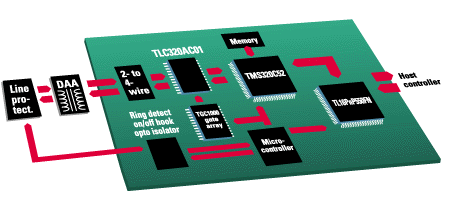


Texas Instruments has introduced three new UARTs: two that are plug-and-play (PnP) compatible, one that offers an extra-deep buffer.
A UART is a universal asynchronous receiver/transmitter. It is responsible for serial-to-parallel and parallel-to-serial data conversion between the PC's data bus and the serial port.
TI has introduced a new plug- and-play UART that allows users to insert an add-in card into a PC and perform almost no configuration. Plug and play is an ISA standard that isolates a peripheral card, reads its resource data, identifies the card, configures its resources and locates a driver for the card, all with little or no user intervention.
The TL16PNP550 is the first UART on the market to include the plug-and-play functionality. It is an upgrade to the previous-generation TL16C550C.
The device provides 10 interrupts along with a three-pin interface to a serial EEPROM where plug-and-play configuration information is stored.
The 'PNP550 features two bypass modes, which will be significant as the industry transitions to plug-and-play capabilities. In the PnP bypass mode, the 'PNP550 can be programmed to bypass the plug-and-play capability. The device then acts as a stand-alone UART. The UART portion also can be bypassed so the device can act as a stand-alone plug-and-play controller.
The TL16PNP100 stand-alone controller, which supports two logic devices, is designed for use on a PC add-in board to provide PnP capabilities. A cost-effective solution, the PnP controller features a simple, three-pin interface to EEPROM memory where information needed during PnP's auto-configuration process is stored. The device interfaces directly to the PC's ISA/AT bus and will require no buffering for data or interrupt signals. The device decodes to I/O chip selects and routes two interrupts to one of six interrupt pins.
As modem data transfer rates increase to 28.8 Kbps and beyond, more and more demands are placed on the CPU.
To meet this demand for faster transmission, with fewer lost characters and system crashes, TI has introduced a UART with a 64-byte FIFO buffer.
TI's new deep First-In, First-Out (FIFO) buffer UART can hold more data before generating an interrupt request, which allows the CPU to continue working as data is transmitted. In addition, the device has customizable triggers that can be set to allow the UART to receive a certain amount of data, not necessarily the full 64 bytes, before issuing an interrupt request.
Most UARTs on the market today have 16-byte FIFOs. TI's new TL16C750 is the only 64-byte FIFO product available. For the low voltage and portable market, the device offers 5-V and 3-V operation, sleep mode and low power mode. These modes reduce power to the UART when no data is coming in to save energy.
All three devices are available now from Texas Instruments and authorized distributors.
TL16PNP550 68-pin PLCC-- $5.60
TL16C750 44-pin PLCC-- $6.95
TL16C750 64-pin SQFP-- $7.95
TL16PNP100 68-pin PLCC-- $4.60
Suggested resale pricing in U.S. dollars per unit in 1K quantity.
May, 1995, vol. 12, no.4
TI Home
Search

Semiconductor Home