 TI Home
  Search Feedback
 Semiconductor Home

For the third consecutive year, the worldwide market growth for semiconductors has blown industry estimates out of the water. This year the market is expected to grow 40 percent, more than double the original 17-percent early-1995 estimate. Digital signal processors, one major growth area, is projected to increase 70 percent by the end of the year.
This growth explosion presents tremendous challenges. And TI is attacking them on all fronts by:
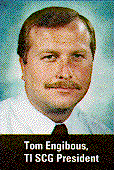
But, while TI focuses on building more capacity, the company continues to meet its commitments today, said Tom Engibous, president of TI Semiconductor Group. For the past 17 consecutive months, TI's overall on-time-to-commit-date delivery performance has been 95 percent or better, an extraordinary achievement in a period of unprecedented growth.
"The work we've done in this area gives us a significant advantage," Engibous said. "We might not be able to ship customers everything they want, but we can tell them precisely when they are going to get something."
Still, immediate solutions such as construction are critical. What are TI's building plans?
Right now with bricks and mortar, TI's joint ventures are building memory capacity, which will double in one to two years.
TI is ramping up production in Dallas at its newest wafer fab, DMOS 5.
TI has accelerated construction on DMOS 5, Phase 2 -- five times larger than Phase 1.
Because of its worldwide joint-venture and shared-investment strategy, TI has probably built as many new semiconductor manufacturing facilities around the globe as any other company.
According to a report in Forbes magazine, there are 40 new wafer-fabrications lines in the works, worldwide, to be completed during 1996. The worldwide semiconductor market in 1994 was about $100 billion. If projections for the market to reach $300 billion by the year 2000 are accurate, the industry will need three times as much capacity.
Starting later this year, TI will convert a significant portion of its EPROM capacity at its manufacturing facility in Lubbock, Texas, to digital signal processors. This supports TI's goal to be No. 1 in digital signal processing solutions.
Explosive growth in DSP applications has triggered a need for the electronic "nuts and bolts" in these systems. For example, customers bought about 50 million new cellular phones worldwide in 1994. That number is projected to double every four years. The average cellular phone contains about $100 worth of semiconductors.
TI will continue to support key EPROM customers worldwide, primarily those in the telecommunications and automotive markets as well as markets that use TI DSP Solutions.
Recently, TI announced capital spending will be increased to $1.45 billion in 1995, up from the previous estimate of $1.3 billion, with much of the increase supporting continued growth in DSPs and mixed signal/analog.
In August, Engibous initiated the 10-percent challenge, a productivity enhancement thrust designed to generate an additional 10-percent gain in output for customers during the remainder of 1995. This will help customers meet their market demand and support the Semiconductor Group's goals of continued growth and market share.
"We worked on process yield in 1994, and we're working now on process yield, stepper productivity and other issues that affect overall productivity," Engibous said. "I think by the end of the year we'll be above industry average. That means we've made a huge amount of progress, but there's still a great deal of opportunity for continued improvements.
"When you combine capital investment with the productivity gains we've made last year and this year, you can look beyond the short-term-capacity issue into the future," Engibous said. "We know where the bricks and mortar go. The funding is there to do it. And we're planning for the capacity."
In 1994, PC sales in the United States surpassed the dollar sales of television sets for the first time. Semiconductor devices now account for between 40 percent and 50 percent of the cost of a PC.
Average growth in the worldwide computer market, which has been running at 15 percent for the past decade, could exceed 20 percent in the next decade. For the first half of 1995, the worldwide PC production is up 23 percent over the first half of 1994. And, for the first nine months of '95, worldwide PC production is estimated to be up 27 percent.
Two factors are helping to cement the PC's staying power.
First is the Internet, a collection of 80,000 networks that enable desk-to-desk connections around the world.
Second is Microsoft's Windows 95. On October 17, 1995, Microsoft reported that the company has sold 7 million copies of the software, either as upgrades or preinstalled on new PCs. International Data Cor-poration (IDC) projects that 60 percent of the PCs sold by the end of the year will include Windows 95 with a total of 19-20 million copies of Windows 95 sold this year.
Will the PC boom continue? Engibous said, "All of the fundamentals look positive for continued growth, based on continued growth around the world. The computer segment is now about 50 percent of the semiconductor market and growing. This increase has fueled the above average growth for the semicon-ductor industry for the past three years, which now averages more than a 30-percent increase, and is con-tributing to the current SC capacity shortage."
The worldwide semiconductor market may more than double in size in the next five years.
If present trends continue, the semiconductor market could surpass $300 billion, according to Vladi Catto, vice president, corporate staff and chief economist. The three-year period ending in 1995 was the strongest in history, with 1995 growth expected to be about 40 percent.
Revenue in the worldwide electronics industry, which reached $690 billion last year, is projected to exceed $1 trillion in the year 2000, according to Dataquest Inc., a San Jose, Calif.-based market research firm.
The Semiconductor Industry Association's book-to-bill ratio, a measure of orders against shipments, was 1.11 in September. That means for every $100 of products shipped or billed, companies received $111 in new orders.
November 1995, vol. 12, no. 8