


TI's new TMS320C82 is the high-performance, low-cost engine for high-volume applications
A high-performance digital signal processor (DSP) that will
enable affordable new applications for homes and offices is
in development by Texas Instruments. The new DSP will perform
more than 1.5 billion operations per second (BOPS) and will
cost $82 in production quantities.
The device, designated the TMS320C82, is the newest member of
TI's TMS320C8x generation of high performance DSPs. The 'C82 integrates
on the same silicon two advanced DSPs, a high-speed floating-point
reduced instruction set computing (RISC) master processor and
enhanced on-chip memory capacity and transfer control.
Affordable new applications
With the 'C82, original equipment manufacturers (OEMs) will be
able to offer multimedia applications that are affordable to consumers
and small businesses for the first time. These applications include
desktop videoconferencing, video phones, 3-D virtual reality graphics
for games, training and other uses.
"What videoconferencing and 3-D graphics have really needed
to take off in volume is a high-performance engine with a price
tag under $100," said Rick Rinehart, TI's program manager
for the 'C82. "The 'C82 will be that engine. No other solution
offers the bang for the buck."
In addition to its imaging and video uses, the 'C82 will serve
as a highly integrated, competitively priced general- purpose
DSP for digital switching in cellular telephone base stations
and other high-speed data communications. With 'C82 designs, OEMs
will be able to fit more channel-switching circuitry--and more
channels--in the same space.
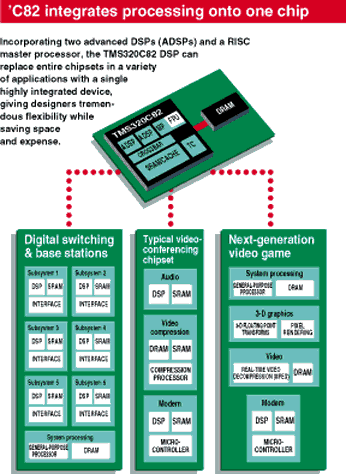
Performance, integration, flexibility
The highly integrated 'C82 can replace approximately 10 processing
units and support devices with a single chip, saving board space,
lowering chip counts and helping reduce manufacturing costs for
the system. With its streamlined architecture, the 'C82 can outperform
six to 10 standard 16-bit DSPs in typical signal processing applications.
In targeted imaging and video applications, it would take 10 to
15 DSPs or general-purpose microprocessors to equal the 'C82's
performance.
As a general purpose DSP, the 'C82 is fully programmable, giving
OEMs maximum flexibility for product differentiation, as well
as the capability of modifying designs quickly in areas such as
video compression, where algorithms are changing rapidly. To assist
in early development, designers can turn to existing 'C8x tools.
"Normally developers expect to pay a premium for flexibility,"
said Rinehart. "With the 'C82, flexibility comes free. We
want OEMs to stretch the limits with this part-not only so they
can add features, but also so they can eliminate specialized components
and minimize hardware redesign."
Crafted for performance
"For the applications we've targeted, the 'C82 will deliver
the same performance as our industry-leading 'C80 DSP," said
Julie Gallagher, TI's 'C8x marketing manager. "Some applications
will still need the full power of the four DSPs in the 'C80. But
for many high-volume applications, the 'C82 will serve just as
well, and keep the price of the finished product on the shelf
much lower.
"For instance, we believe that the 'C82 will make it possible
for OEMs to offer desktop videoconferencing systems for less than
$500. And consumer game machines will be able to merge video with
3-D graphics, a capability that can only be found on workstations
today."
TI's TMS320C82 DSP features
- Two advanced DSPs (ADSPs) with 64-bit instruction words
- RISC master processor with 100-MFLOP IEEE floating-point unit
- Increased memory per processor-total 44 Kbytes on-chip RAM
- Crossbar switch supports 2.6 Gbytes/s on-chip bandwidth
- Optimized transfer controller supports intelligent DMA
- 0.5-micron CMOS, 3.3-V operation
- Low-cost 240-pin QFP
Sampling for TI's TMS320C82 DSP is planned for the second quarter
of 1996, with volume production projected for the second half
of 1996. Volume pricing is planned at $82 in quantities of 25,000.
September 1995, vol. 12, no. 6
Return to Integration Home Page
 TI Home
  Search Feedback
 Semiconductor Home
(c) Copyright 1995 Texas Instruments Incorporated. All rights reserved.
Trademarks, Important Notice!