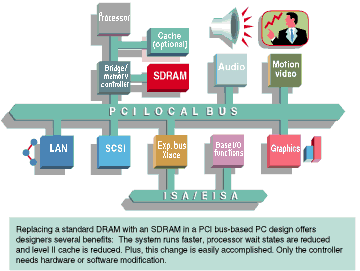


"The release of these two devices to production reflects TI's continuing leadership in the drive to solve the memory bandwidth problem," said Bob Harrison, TI's MOS memory marketing manager. "We expect SDRAMs to become the standard memory architecture, and as the need for greater memory bandwidth migrates to PCs, TI will be ready."
Siemens Nixdorf Informationssysteme AG has selected TI's SDRAM as main memory in its next generation of high-performance mid-range servers. These servers will be used in accessing large amounts of data for insurance companies, banking systems and financial institutions. Siemens Nixdorf plans to develop PC and mainframe systems with a flow-through architecture based on SDRAM.
"Server users need fast access to large amounts of data. To meet this need SNI's next generation of high-performance workgroup and departmental servers will rely on high-speed SDRAMs to provide access to more than 1 gigabyte of main memory," said George Mueller, SNI engineering development manager. "A combination of speed and cost-effectiveness makes SDRAM the optimum solution in this application and also makes SDRAM the solution of choice for future systems."
Current production 16M SDRAM devices include 66 MHz and 83 MHz versions, with 100 MHz versions expected later this year. The 1Mx16 devices, optimized for PC environments, are in development and will be sampled before the end of the year.
TMS626402 4Mx4 44-pin TSOP $90
TMS626802 2Mx8 44-pin TSOP $90
Suggested resale pricing in 100-unit pricing.
"Two years ago the industry settled on a specification for synchronous DRAMs at JEDEC, and Hitachi is currently sampling 16M DRAMs and modules. The broad industry support as further evidenced by this announcement from Texas Instruments is the critical factor in the success of a new memory technology."
"It is apparent that rapid advancements in processors for workstations and personal computers are demanding the same progress in DRAMs. NEC strongly believes new-generation DRAMs, such as synchronous DRAMs, will move rapidly to fill customer needs in both main memory and graphics."
"The trend toward synchronous DRAM technology is a powerful one, dictated by speeds of the new generation of microprocessors. Our development programs are already yielding our first generation of new products. Texas Instruments' announcement supports Fujitsu's view that synchronous memories are not only logical but necessary."
"As processor and memory performance requirements increase, system designers may not be able to use traditional asynchronous DRAM interfaces effectively at very high speeds. We {at Oki} see the synchronous architecture as one of the major new industry trends that offers the capability to support 66/100 MHz and beyond."
"Toshiba is sampling the 16M SDRAM (x4/x8) now. We are very enthusiastic and committed to synchronous DRAM due to its high performance and scaleability whereby allowing systems to open bottlenecks and establish new performance baselines."
September 1995, vol. 12, no. 6
TI Home
Search

Semiconductor Home