



In this Issue New DSPs invigorate digital set-top boxes TI delivers customizable digital wireless baseband platform Third Parties pilot DSP Solutions into the mainstream New x2 modem chip sets speed OEM production Chip set supports FLEX messaging New link-layer added to 1394 product family PCI bus-to-cardbus controller complies with PC97 guidelines TI announces family of Universal Serial Bus interface chips |
Chip set supports FLEX messagingA new two-chip DSP Solution from TI will enable OEMs to rapidly develop messaging devices that conform to the emerging FLEX™messaging protocol.
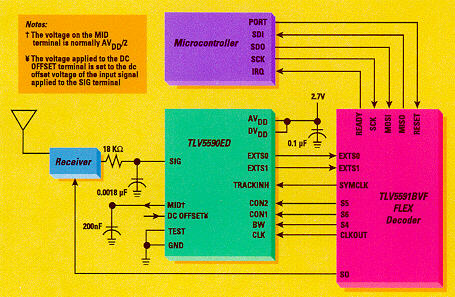
Targeted at alphanumeric pagers and other embedded wireless messaging applications, the new TMS320FLEX1 chip set simplifies implementation of the FLEX protocol in these systems by interfacing directly with most receivers and off-the-shelf microcontrollers. As a result, pager OEMs can develop FLEX-compliant products quickly from existing designs with minimal hardware changes.
The chip set consists of the TLV5591 FLEX Protocol Decoder, a signal processor that decodes the FLEX messaging protocol transmission, and the TLV5590 A/D Converter, which converts the analog signal from the receiver into a digital signal for decoding by the TLV5591. A complement to the chip set is FLEXstack™software, designed to facilitate application development. Running on the system processor, FLEXstack handles interchip communications and interprets host commands for the TLV5591, simplifing development of OEM software. FLEXstack is available on Motorola 's World Wide Web site at The new product supports the 1600-, 3200- and 6400-bit-per-second (bps) transmission speeds of the FLEX standard, allowing OEMs to easily migrate their end equipments up the performance path as higher transmission rates are supported by flex service providers. The substantial increase in the number of subscribers per channel can help lower infrastructure costs. The chip set helps systems provide up to five times the battery life of older paging protocol standards, enabling miniaturization and improvements in design because of the smaller batteries required. With support for alphanumeric messages and group pages, the chip set also helps improve signal integrity for greater error protection and positive message termination. Samples of both the TLV5590 A/D Converter and TLV5591 FLEX Protocol Decoder are available now, with volume production planned for January. Purchase of the TMS320FLEX1 chip set satisfies all FLEX protocol licensing requirements for OEMs. No separate licensing agreement with Motorola is necessary. The TMS320FLEX1 chip set is $9.80 in 1K quantities. |
