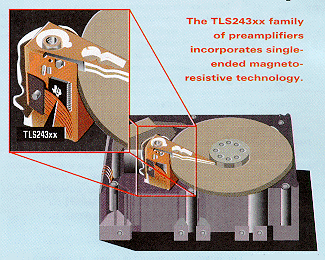


Texas Instruments has introduced its second generation of preamplifiers incorporating single-ended magnetoresistive (MR) technology. The new device enables designers in the highly competitive disk drive industry to increase drive density, reduce power and lower the cost per megabyte of storage.
The TLS243xx single-ended
MR preamplifier achieves data rates that are compatible with requirements
of desktop PC computers while needing only a single 5-V power
supply. Because of its small form factor, surface mount package,
the preamp can be placed on the drive's head stack to reduce noise
that can compromise performance. Higher reliability is achieved
with the fault detection features.
"TI's adoption and implementation of single-ended MR technology in this new family of preamplifiers underscores TI's confidence in single-ended MR technology as the technology of choice for mainstream hard drives," said Deames Davis, mixed-signal marketing manager of TI's Hard Disk Drive Business Unit. "With our worldwide design and manufacturing focus, TI is in a strong position to reduce the time-to-volume production as MR technology enters drives targeting the mainstream and portable PC markets."
The TLS243xx single-ended MR preamplifier is just one of a suite of TI products for the hard disk drive industry. These products, a line of Digital Signal Processing Solutions (DSPS) optimized for hard disk drive applications, include voice coil motor (VCM)/spindle motor controllers and drivers, DSP-based controllers, read channels, SCSI interfaces and system memory. TI is the leading supplier of DSP solutions for hard disk drive systems.
TI's first family of single-ended MR preamplifiers (TLS241xx)
was introduced in March 1995. The second-generation family of
devices has been proven in production drive environments to operate
in excess of 110 Mbps using a catalog PR4 read channel. TI also
offers a family of differential preamp devices.
The TLS243xx is available in thin-shrink-small-outline-package (TSSOP), allowing the MR preamp to be placed on the drive's head stack to reduce system noise that can compromise performance. The use of a standard plastic package minimizes the need for expensive chip-on-flex assembly. Two-, four-, six-, eight- and 10-head versions are available.
In addition to standard write-and-read fault detection, TI has added thermal asperity (T/A) detection to improve T/A recovery in the read channel. This family of preamps also achieves fast write-to-read recovery times by allowing the MR bias current to be active during the write mode. An additional feature of the TLS243xx is the ability to reduce drive manufacturing time by performing simultaneous multi-channel servo write.
The TLS243xx devices are available now from Texas Instruments.
TLS24306 38-pin TSSOP $6.00
Suggested resale pricing in U.S. dollars in 1K quantities.
------------------------------------------------------------------
TSSOP package allows device              Lower cost-per-megabyte
to be placed on head stack
-------------------------------------------------------------------
Industry-proven current                  Lower risk
bias/current sense architecture
-------------------------------------------------------------------
Thermal asperity detection               Enhances read-back
performance
-------------------------------------------------------------------
Boost circuit                            Increased read bandwidth
-------------------------------------------------------------------
Fast write-to-read recovery              Minimizes wasted disk area
-------------------------------------------------------------------
Operates from a single +5V               Low power consumption
supply; features low-power idle mode
-------------------------------------------------------------------
Why is magnetoresistive technology more advantageous than the more traditional thin film?
MR technology allows an increase in areal density and faster data rates far beyond what is achievable with inductive thin film technology.
MR heads use dual head elements for reading and writing (one head each), unlike thin-film heads that use the same element for both functions.
The writing element in the MR drive is the same technology as the inductive coil used in thin-film heads, except that it can be optimized to support higher data rates.
In an MR head, the reading element is magnetoresistive. The signal is determined by the change in resistance of the element. The strength of the MR read signal is three to five times greater than that of a thin-film head, allowing bits to be closer to- gether without increasing the error rate. This allows disk drive designers to achieve densities of several gigabits per square inch without spinning the disks faster.
Currently, MR is more difficult to manufacture because the technology is new, and like any new technology there is a learning curve.
Several major hard disk drive companies have announced products
using MR technology. Most drive manufacturers are investigating
MR technology for use in future products.
February 1996, vol. 13, no. 1
TI Home
Search

Semiconductor Home