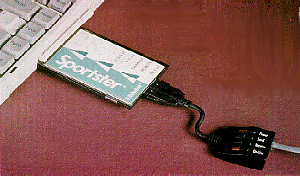


That's why U.S. Robotics of Skokie, Illinois, one of the world's largest manufacturers of information-access equipment, such as modems and enterprise-wide access devices, has drawn upon the resources of Texas Instruments to jointly develop affordable products that can take advantage of the introductory time when product margins are highest.
Since the mid-1980s, TI and U.S. Robotics have developed more than a traditional customer-vendor relationship. The two firms have worked together to coordinate U.S. Robotics' technology requirements with TI's latest product developments to shave costs and ramp- to-volume production time. Cooperation enables both to benefit from the narrow market window for each improvement on modems and fax modems, as well as the networking devices and computer interfaces used to make computers talk with one another.
"TI's full suite of digital signal processing solutions -- including digital signal processors (DSPs) that meet the criteria for our next generation products -- have been critical to a successful relationship," said Robert C. Suffern, director of U.S. Robotics' architecture development group. U.S. Robotics has incorporated TI's analog interface devices (AICs), numerous products in TI's DSP product family and application-specific integrated circuits (ASICs) to improve the cost/performance ratio of U.S. Robotics products and cut time-to-market.
"U.S. Robotics has taken a unique approach in its product development strategy," said Charlie Gonsalves, TI's marketing manager for the DSP group. "A lot of modem manufacturers use technology in their products that requires an entire product architecture to be redesigned to add new features. DSPs are software programmable, so U.S. Robotics designers have the flexibility to define and add features without changing the system design."
"Programmability allows us to control the inner workings of the modem to meet new demands," said Dale Walsh, U.S. Robotics' vice president for advanced development. "This is especially important in our rack equipment."
Using the same TI DSPs for multiple products allows U.S. Robotics to achieve economies of scale in purchasing, as volume purchases bring costs down. The reduced set-up times required when using the same DSP for different product lines also yields increased production for U.S. Robotics. If U.S. Robotics can leverage its base product design architecture, it can increase the company's manufacturing efficiencies, because is spreads overhead across a greater number of units.
"Making information available to our customer in a timely manner is critical to their success because of the 18-month market window," explained Gonsalves. "That's why TI shares information freely as our customers are developing products, so they can design their plans around our technology."
"TI's forward-thinking approach to business is an ideal match
for U.S. Robotics. TI has helped us by adapting or developing
DSP solutions that closely match the nature of our market challenges,
so that in the end we have the best performance per cost part,"
said Bernie Sepaniak, director of research and development for
U.S. Robotics' Personal Communications Division. "The collaboration
means that we do not over-design or under-design the part for
our product, so that the silicon's optimum for the solution."
"Also, because we work with TI from the beginning of their product design cycle, they can also quickly reach the production capacities we require, which allows us to get our new products to market way ahead of the competition," Sepaniak said.
U.S. Robotics' Suffern credits TI's support technologies for enhancing timely product development and flexibility. "For example, by utilizing TI's flexible development tools, we were able to be the first to market with a thoroughly V.34-compatible modem, having a 28.8 kilobit/second data rate -- twice as fast as other products that previously were available," he said.
The relationship compelled TI to develop special products for one of U.S. Robotics' Personal Computer Memory Card Interface Association (PCMCIA) application cards and pocket modems. "U.S. Robotics wanted to bring a DSP-based PCMCIA solution to the market that used technology only available with U.S. Robotics' products," Sepaniak explained. TI wanted to develop a more standard product. Combining the expertise of both staffs and jointly pursuing technology neither had previously developed led to a unique solution for providing a PCMCIA interface and integrating PCMCIA with U.S. Robotics' chipset on one part. The effort led to several joint patent disclosures and a generic solution for the market.
The relationship has required constant planning. In addition to the current product offerings, TI and U.S. Robotics are working on the next generation and have defined the architecture that will follow that, according to Gonsalves. "We try to stay two product generations ahead," he said.
February 1996, vol. 13, no. 1
TI Home
Search

Semiconductor Home