 http://www.ti.com/dsps.

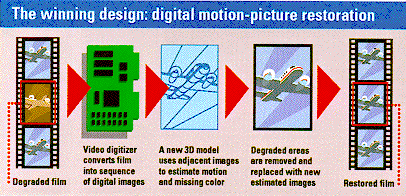
Two students from the Nanyang Technological University (NYU) in Singapore split a prize of US$100,000 when they won the TI DSP Solutions Challenge. The worldwide contest is the first of its kind to encourage college students to use digital signal processors for new applications.
Dilip Krishnan and Showbhik Kalra, second-year computer engineering students, devised a way to restore damaged motion picture frames quickly and effectively.
Krishnan and Kalra's design is implemented on a network of 15 TMS320C40 processors connected in a tree configuration. Two different parallel algorithms create an improved algorithm which mimics linear speed-up.
The restoration process begins by converting the degraded film into digital form using a real-time video digitizer. A 3-D model is created from information collected from the redundant information contained in frames preceding and succeeding the damaged frame. Two of the dimensions in the model describe changes within the image frame and the third describes the changes between frames. Each frame is then restored individually so restored images can be used to repair subsequent frames.
"It caught the imagination of all of the judges," said lead judge Gene Frantz, TI fellow and DSP applications manager. "We all know that old films, which we like to watch, are potted and scratched. This fixed that problem. It's something we experience in everyday life."
Whether recorded on flammable nitrate-based film that decays rapidly or made with today's safer, acetate-based film, professional and home movies are susceptible to degradation by gouges, scratches and dirt accumulation. To date, the restoration of a classic motion picture has been a labor-intensive, costly undertaking. For example, the restoration of Disney's "Snow White" took 18 weeks using 40 workstations with 60 operators working three shifts a day, seven days a week.
The system that Krishnan and Kalra helped develop opens the way to more advanced systems that could handle such projects automatically, requiring less time, money and fewer people.
The Singapore team was one of three finalists chosen from a field of 230 entries. The University of Maryland (USA) team's design featured a way to teleconf erence with a laptop. The team from Ecole Francaise d'Electronique et d'Informatique (EFREI) in France designed a Doppler radar system that would help small planes land without using heavy onboard equipment. Each of these teams received US$10,000.
Although all the finalists had strong programs, Frantz said the Singapore team's win was well-deserved.
"They understood the concepts very well," he said. "They
did an extensive amount of work, they knew their material, they
were well-prepared. They met all of the criteria. That's what
got them over the top."
"This is the first time a worldwide contest with this type of prize has been offered," said Torrence Robinson, TI's Semiconductor Group university program manager and contest coordinator.
In addition, Robinson said, this is the first time TI will work with a third party to track where and how the contestants enter the workplace.
For information about TI's DSP Solutions Challenge '97, visit
the TI website at http://www.ti.com/dsps.
June 1996, vol. 13, no. 4
TI Home
Search
Semiconductor Home