

View your personal Web page, or receive
a weekly e-mail newsletter for what's new.
Access TI's on-line technical documentation.
Register today at TI&ME, and start making the most of your TI&ME.


|
September 1996, vol.13, no. 6
|
|
Access TI's on-line technical documentation.
|
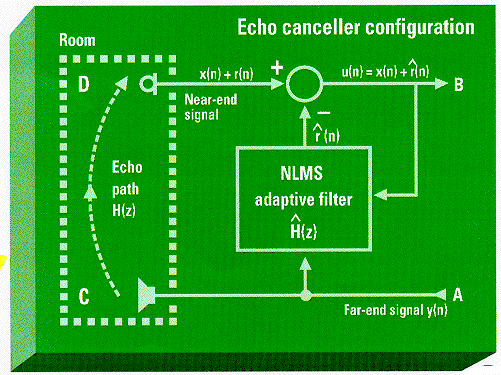
Acoustic Echo Cancellation -- Algorithms and Implementation on the TMS320C8xThis application report describes the implementation of an integrated N-tap digital acoustic echo canceller on the TI TMS320C8x parallel processor (PP). The report presents a brief discussion of generic echo cancellation algorithms.
The implementation considerations for a 512-tap (64-ms span) echo canceller on the TMS320C8x are described in detail, as well as the software logic and flow from each program module. Line echoes are not considered in this report.
In recent years, speakerphones and hands-free cellular phones have been used widely around the world for audio-conferencing and video teleconferencing applications. A speakerphone or a hands-free cellular phone allows full-duplex communication without having to hold the phone. Full-duplex means voices on both ends of the line are transmitted continuously, as with a normal telephone. The speech from the far-end caller is broadcast by the speakerphone or the hands-free cellular phone and then repeats itself by bouncing off the inside surfaces of the room. This repetition of sound is called an echo. Echoes are picked up by the near-end microphone, creating a feedback loop where the far-end caller hears an echo of his or her own voice. To solve this problem, developers are using the digital signal processing technique of acoustic echo cancellation (AEC) to stop the feedback and allow full-duplex communication. | |
 Integration Home Integration Home
|
TI Home
Search
Semiconductor Home