

View your personal Web page, or receive
a weekly e-mail newsletter for what's new.
Access TI's on-line technical documentation.
Register today at TI&ME, and start making the most of your TI&ME.


|
September 1996, vol.13, no. 6
|
|
Access TI's on-line technical documentation.
|
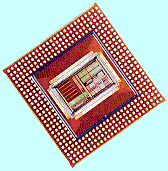
New multiprocessor DSP for visual communications applicationsThe newest member of the highest-performing family of multiprocessor digital signal processors (DSPs) is now available in sample quantities from Texas Instruments. The new TMS320C82 DSP will bring high performance and lower power consumption at an affordable price to digital video, graphic, imaging and other high-speed visual communications applications.
TI is also sampling a higher- frequency version of its flagship TMS320C80 DSP. 'C82 at 50 MHzFabricated using 0.5-micron CMOS technology, the initial version of the 'C82 operates at 50 MHz with a typical power dissipation of less than 3 watts. It interfaces to extended data out (EDO) DRAM for faster memory access, as well as to other types of memories, including DRAMs, SRAMs, VRAMs and SDRAMs. The device is planned for production in low-cost, small-footprint ball-grid array (BGA) packages to save both package expense and board space.'C80 at 60 MHzIn addition to sampling the 'C82, TI is converting its 'C80 to 0.5- micron production versions. This allows for extending the family to 60 MHz and beyond as well as reducing cost and power dissipation to only 5 watts. Featuring a multiprocessor architecture with four on-chip DSPs, the 'C80 is capable of achieving more than 2 BOPS for applications that need the highest levels of performance.For system developers, the pieces are in place now to start their 'C8x designs with a full suite of software and hardware development tools. Samples availableThe 50-MHz TMS320C82 DSP is available now in sample quantities from TI. The device is packaged in a 352-lead BGA. Production quantities are planned for 1Q97, with pricing planned at $82 each in quantities of 25,000.The new 60-MHz versions of the TMS320C80 DSP are available now in sample quantities from TI, with production quantities planned for 4Q96. Pricing is $176 in 25,000 units. Versions of the 'C80 operating at 40 and 50 MHz are already in full production. The device is currently packaged in a 305-lead pin-grid array (PGA). | |
 Integration Home Integration Home
|
TI Home
Search
Semiconductor Home