


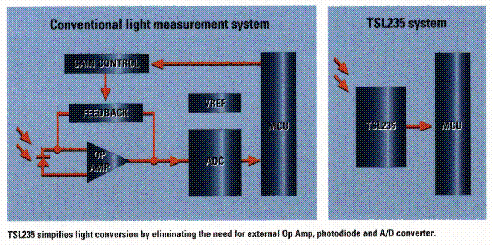
The TSL235 offers a high-performance, low-cost alternative to conventional discrete combinations of photodiodes, amplifiers and A/D converters. The device can be used anywhere ambient light is measured, or when using light as an analog indicator of some parameter such as transmittance of a fluid or other medium, or reflectance of a surface.
Compact size makes it suitable for portable applications such as cameras, handheld diagnostic equipment, and light meters. Other applications include lighting controls, display contrast adjustment, fluid turbidity/transmissivity measurement, color detection, flame monitoring, and visual process control.
The TSL235 light-to-frequency converter combines a photodiode and a high-performance current-to-frequency converter circuit in a compact 3-lead plastic package. It offers direct high resolution conversion of light intensity to a digital format. This provides a simple way to process a wide dynamic range of light levels using inexpensive microcontrollers without analog signal conditioning or A/D converters.
The output of the TSL235 is a 50% duty cycle square wave with frequency directly proportional to the light intensity on the photodiode. The device operates over a 120 dB light intensity range with a full-scale output of 500 kHz. The digital CMOS-compatible output may be directly interfaced to a microcontroller input port, timer input, or to digital counting circuitry. Low power consumption (5 mW) and operation down to 2.7 V make the TSL235 ideal for battery-operated or 3 V systems. The device is temperature compensated to 100 ppm/°C and linearity error is typically only 0.2 percent from 0 to 100 kHz.
Evaluation module available to support design-in
Vol 10, Fall 1994