



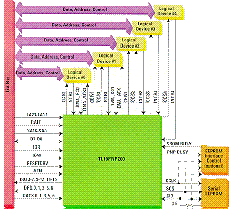
The TL16PNP200 stand-alone plug-and-play controller offers all of the functionality needed to fully comply with Microsoft's Windows 95 plug-and-play requirements. The 'PNP200 can be used to add plug and play functionality to expansion boards including fax/modems, graphics and ISDN cards. Plug-and-play offers a means for peripherals to communicate with a machine's BIOS and operating system to resolve resource conflicts with little or no user intervention.
The 'PNP200 supports up to five logical devices in two different modes of operation. Mode 0 supports two devices and offers memory, I/O, interrupt and DMA for each of the devices. Mode 1 supports the full five devices with both I/O and interrupts, and supports DMA for two of these devices. These two modes offer the flexibility to trade-off which functions work the best within your system.
The 'PNP200 offers the full 16-bits of I/O address reach along with 24-bits of memory address decoding. In addition, it offers interrupt mapping to any of 11 interrupt request signals on the ISA bus. These features give the designer access to the full range of system resources available.
The 'PNP200 has a three terminal interface to an external EEPROM where resource data, power up defaults and other board specific data can be stored. This EEPROM can be programmed externally or within the system by a EEPROM programmer. The TL16PNP200 is the third product in a family of plug-and-play controllers from Texas Instruments. The other two products are the TL16PNP550A, which adds plug-and-play functionality to a UART, and the TL16PNP100A, a standalone plug-and-play controller that supports two logical devices.
The TL16PNP200 is available in an 80-pin quad flat pack.
 TL16PNP200
Vol 17, June, 1996
 Return to Showcase Home Page