



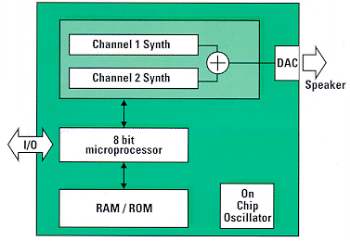
The MSP50C3x family is TI's new generation of speech synthesizers. It pairs two channels of LPC synthesis with a built in 8-bit microprocessor for a flexible approach to low cost consumer speech synthesis. Suitable for games, toys, answering machines and other consumer orientated products, the members of the MSP50C3x family offer the flexibility, power, and low price to add speech to a wide range of products.
The MSP50C3x family contains two channels of LPC-12 synthesis. One channel can be played individually, or both channels can be played together. If desired, the DAC can be accessed directly to provide PCM or ADPCM sounds at the same time as the LPC. This can be useful if a background sound effect or music is desired behind the LPC voice.
 The on-chip microprocessor supports 61 instructions with an execution
rate of up to 1.2 MIPS. The ALU supports add, subtract, AND, OR,
and single cycle multiply functions. The family includes 32 12-bit
RAM locations and 224 8-bit RAM locations. The microprocessor
incorporates a seven level call stack and a two level interrupt
structure.
The on-chip microprocessor supports 61 instructions with an execution
rate of up to 1.2 MIPS. The ALU supports add, subtract, AND, OR,
and single cycle multiply functions. The family includes 32 12-bit
RAM locations and 224 8-bit RAM locations. The microprocessor
incorporates a seven level call stack and a two level interrupt
structure.
The ten I/O pins are configurable under software control to be either inputs or outputs. As inputs, they can be configured to be either high impedance or with a passive pull-up resistor. As outputs, they can be configured to be either totem pole or open drain. A special wake-up feature allows the device to be placed in a low power 'sleep' mode from which it will wake up upon a transition on any of 8 software definable pins.
A variety of ROM sizes are offered from 16 Kbytes (sufficient to store 1 minute of LPC speech) to 64 Kbytes (sufficient to store 4 minutes of LPC speech). One time programmable (OTP) versions are available to support prototyping and rapid product development cycles.
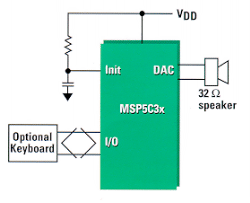
The device is equipped with a pseudo-pulse density modulation type DAC which can be used to directly drive a 32 speaker.
Most applications will use the on-chip oscillator with no external components to reduce total system cost. If desired, an external clock signal can be utilized, or an optional crystal or ceramic resonator oscillator can be used for increased performance.
The device is available in die form or a 16-pin DIP.
Vol 18, August, 1996
 Return to Showcase Home Page