



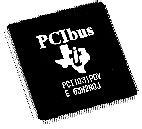
 DALLAS (June 17, 1996) -- A new PCI bus-to-PC Card™
controller device from Texas Instruments (TI) allows designers
of notebook and desktop PCs to add Zoom Video capabilities without
impacting overall system performance. This new controller device
is compatible with the higher performance 32-bit CardBus(TM) standard,
allowing OEMs a simple migration path to next generation platforms..
DALLAS (June 17, 1996) -- A new PCI bus-to-PC Card™
controller device from Texas Instruments (TI) allows designers
of notebook and desktop PCs to add Zoom Video capabilities without
impacting overall system performance. This new controller device
is compatible with the higher performance 32-bit CardBus(TM) standard,
allowing OEMs a simple migration path to next generation platforms..
The PCI1031 device interfaces a computer system's PCI bus to two 16-bit PC Card (PC Card 16 or R2) slots where credit-card-sized PC Cards specified by the PCMCIA (Personal Computer Memory Card International Association) can be inserted for accessing peripheral devices, such as modems, multimedia, and networks.
"This device brings Zoom Video to value line notebooks, giving OEMs another way to differentiate their product" said Ed Agis, PCIbus marketing manager for TI. "Because TIs PCI1031 is pin-for-pin compatible with Tis 32-bit PCI1130 CardBus controller, notebook vendors now have an efficient way of developing next generation platforms, that require the higher bandwidth capabilities of CardBus in order to reduce their time to market deployment cycle."
Zoom Video allows a user to display full motion video on a computer's screen without slowing down the performance of the system. For example, a portion of the display could be used as a video window and this would not slow down other application programs that the user may be running at the same time. Zoom Video routes the video signals directly to the display's graphics controller card and the audio signals directly to the system's audio card rather than sending them over the system's PCI bus where this additional traffic could degrade the performance of the entire system.
Both TIs 16-bit PCI1031 and 32-bit PCI1130 CardBus controller have compatible register sets. System software developed for the PCI1031 can easily be migrated to the higher performance PCI1130, simplifying the extension of an OEM's product line by providing additional bandwidth to address future applications that require the enhanced performance found in the PCI1130.
The PCI1031 offers a number of features that allow it to be designed into a system with relative ease. The device supports either of two direct memory access (DMA) methods as well as three different types of programmable interrupts. The system designer can choose either PCI Way (distributed) DMA or the Intel-sponsored PC/PCI DMA. The types of programmable interrupts supported by the PCI1031 include parallel interrupts, which are backward compatible with older ISA-based (Industry Standard Architecture) PC cards, serial interrupts, that require only one pin on the PCI1031 to implement, and PCI interrupts as defined by the PCI specification and which require only two pins on the PCI1031.
A PC with a PCI1031 controller will support all non-CardBus PC cards, since the device is fully compatible with the register set (Intel 82365 SL-DF) used by these cards. In addition, the PCI1031 complies with the PC Card 95 specification, Intel's ExCA programming model and the PCI bus 2.1 specification.
Adding to the flexibility of the PCI1031 is its ability to operate in an environment with mixed power voltages. It will interface to either a 3.3V or 5V PCI bus and, at the same time, support either 3.3V or 5V PC Cards. Integrated power management features extend the battery life of portable systems by automatically switching the PCI1031 into a low-performance mode when the PCI1031 is not being used or when high performance is not needed.
Reader Inquiry: 1-800-477-8924, ext. 5300
Please refer to Profile # SC-96028
TRADEMARKS:
CardBus and PC Card are trademarks of the Personal Computer Memory Card International Association.
Search the Semiconductor News Release Archives
TI Home
Search
Semiconductor Home