


|
Headlines
|
Industry's First 3.3-Volt IEEE 1149.1 Boundary Scan Test Bus Controller Simplifies Embedded Test
TI's LVT8980 eTBC is 50 percent smaller than the previous generation test bus controller, making boundary scan test easier to design into compact, space-sensitive applications, including hand-held test devices. The eTBC also features an easy-to-program 8-bit interface to a microprocessor or digital signal processor (DSP). In an embedded BIT application, tests developed in a high-level programming language such as C/C++ would be initiated by the system's processor and converted to boundary scan's serial bus protocol by the eTBC. The eTBC would then drive the test vectors over the boundary scan test path linking many of the integrated circuits on-board. In addition, eTBCs or TI's Addressable Scan Port (ASP) device can be placed on multiple boards in a backplane to perform system-level tests. "Since the eTBC uses much less silicon and we are able to take advantage of our very efficient fabrication processes, we believe the eTBC will be a price/performance leader in the market", said Pradeep Bardia, TI's marketing manager of JTAG/Boundary Scan Logic Products. "The smaller size, lower power and simpler programming of the eTBC suddenly makes built in test much more feasible for systems where it has not been considered in the past. This should open the door for another wave of boundary scan applications, which will make many of today's electronic systems more reliable and maintainable."Boundary scan self-test capabilities are becoming much more prevalent in the computer and communications industries as reliability and maintainability become increasingly critical. Internetworking, telecommunications, fault-tolerant computers and other high-availability systems have included boundary scan test for some time, but now personal computers (PCs) and other business systems are also featuring this technology as a way of assuring the reliability of these systems. In fact, the PCI bus specification requires that the five IEEE 1149.1 (JTAG) test bus signals be provisioned at edge connectors on PCI bus motherboards. Computers or communication equipment with boundary scan BIT are able to monitor the on-going operation of the system, identify a functional problem before it adversely affects the operation of the system and notify human operators so that the malfunction can be corrected. Additionally, diagnostics from this bit can be uplinked to a service depot such that field service personnel can be dispatched immediately with all required replacement modules in hand. Replacing the malfunctioning device or module will rapidly return the system to operation. TI's LVT8980 eTBC is the latest addition to the broadest family of boundary scan integrated circuits in the industry. A military version of this device is expected to be available in the first half of 1997. Pricing and Availability
Production samples of the LVT8980 are available now from Texas
Instruments and its authorized distributors. Suggested resale
pricing in quantities of 1,000 is anticipated to be under $10.
NOTE TO EDITORS:
The JTAG/IEEE 1149.1-1990 standard, adopted in February 1990,
had its origins in the work of the Joint Test Action Group (JTAG).
After forming the organization in Europe in 1985, JTAG members
began working to develop economical test methodologies for systems
designed around complex ICs and assembled with surface-mount technologies.
JTAG grew to become an international body and its members included
representatives of computer and semiconductor manufacturers, universities
and the U.S. Department of Defense.
After JTAG conferees developed a specification for a four-wire
serial scan test bus, the IEEE 1149 Test Standards Committee adopted
the specification, prepared the 1149.1 proposal and managed the
process that led to the standard.
Texas Instruments has supported the specification since it joined
JTAG in 1986, and the company has taken a leading role in providing
hardware, software and design tools that back the IEEE standard.
The JTAG/IEEE 1149.1-1990 standard is also a standard of the American National Standards Institute (ANSI).
|
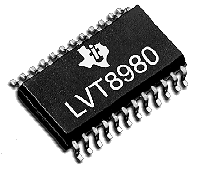 DALLAS (Oct. 21, 1996) -- The industry's first 3.3V IEEE 1149.1
(JTAG) boundary scan embedded test bus controller (eTBC) is now
available in sample quantities from Texas Instruments (TI). Because
of the smaller size, lower power and simpler software interface
of the eTBC, system designers will be able to implement system-level
built in test (BIT) much faster and in a wider range of systems,
such as PC servers, hubs, routers, bridges and other internetworking
products, telecommunications switches and repeaters, fault-tolerant
computers and high-end mass storage systems.
DALLAS (Oct. 21, 1996) -- The industry's first 3.3V IEEE 1149.1
(JTAG) boundary scan embedded test bus controller (eTBC) is now
available in sample quantities from Texas Instruments (TI). Because
of the smaller size, lower power and simpler software interface
of the eTBC, system designers will be able to implement system-level
built in test (BIT) much faster and in a wider range of systems,
such as PC servers, hubs, routers, bridges and other internetworking
products, telecommunications switches and repeaters, fault-tolerant
computers and high-end mass storage systems.