|
Headlines
Additional Documents:
Reader Inquiry: 1-800-477-8924, ext. 4600
|
First General Purpose IEEE 1394 Link-Layer Optimized for use in Consumer Electronics and Computer Peripherals
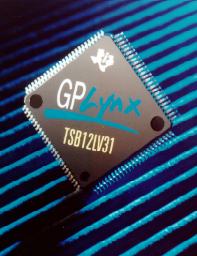
DALLAS (Oct. 21, 1996) -- Designers of consumer electronics and computer peripheral equipment will now find it easier and even less expensive to integrate the IEEE 1394-1995 high speed serial bus with Texas Instruments' (TI) new link-layer chip. The link-layer device will accelerate the merging of consumer electronics and computers by greatly simplifying the implementation of the 1394 high performance serial bus. TI's new chip is the industry's first general purpose 1394 link-layer device with a 8/16-bit interface to be available in production quantities. TI was the first company to develop and market 1394 silicon and is currently offering a third generation of products. The new device, designated TSB12LV31 and called GPLynx, will be used by consumer electronics vendors in digital cameras, televisions, CD players, tape decks and more. It will also be designed into computer peripherals such as printers, scanners, CD ROM drives, hard disk drives, digital video disk (DVD) drives and others. "We've been able to capitalize on our experience with 1394 to make a general purpose link-layer device available sooner than other companies could. It's easier to produce a device such as this when you've been working on 1394 for four years and are now releasing our third generation of complete 1394 solutions," said Larry Blackledge, TI's serial bus business manager.
"Since we've been providing 1394 devices longer than any
other vendor, we know what customers need to easily and quickly
migrate to 1394. Design Kits with full software support, including
support for Windows 95 using Microsoft's 1394 API in our PCI-based
kits -- all these factors are crucial to the total package approach
we've adopted toward 1394," Blackledge said. GPLynx Meets Customer Needs"GPLynx allows our notebook camera to send isochronous video per the 1394 Trade Association's Camera Specification," says Yong Hee Han, senior research engineer of LG Electronics, Inc., whose brand is Goldstar. "TI's GPLynx and 100 Mbps phy form a cost-effective solution that will enable Goldstar LGE to introduce our 1394 notebook camera at a desirable price/performance point." "We designed the GPLynx device into the digital camera we are developing because the 1394 standard is the only bus protocol currently available that allows full video frame rate data to be imported directly to the computer without any specialty video cards," said Dan Harmon TI's CCD Area Array Products Marketing Manager. "The GPLynx allows us to introduce a product in a price-sensitive marketplace and offer the customer a significant overall system cost savings versus existing digital camera configurations as well as offering superior technical advantages. By using 1394 with GPLynx we were able to meet our cost goals and provide the level of performance needed to succeed," Harmon said. Low Power ConsumptionGPLynx is a low-power CMOS device that operates at 3.3V and can interface to 3.3V or 5V devices. Low power consumption is particularly important in portable applications such as notebook and laptop computers where peripheral equipment often runs off of the system's battery. Low-power components are critical for extending the life of batteries in portable and handheld systems.The GPLynx will support both asynchronous and isochronous data transmissions. Isochronous data transmission is usually used in real-time or time-critical applications such as full-motion video and audio which make 1394 well suited to many consumer electronics and computer applications. 1394 isochronous bandwidth is guaranteed on-demand to specified applications, assuring a constant flow of data for time-critical applications. GPLynx has a programmable 8- or 16-bit microcontroller interface, making it compatible with a wide selection of standard microcontrollers and DSPs used in consumer electronic equipment and computer peripherals. It also incorporates a separate 8-bit, high speed isochronous data interface with an integrated data mover for high volume isochronous data. An internal 200-byte FIFO (first in, first out) memory on the GPLynx is used to facilitate asynchronous and isochronous operations. Depending upon the needs of the application, this FIFO can be logically partitioned into two memory spaces of any size up to 200 bytes.
The device works with currently available 1394 physical-layer
devices to provide 1394 speeds of 100 or 200 Megabits per second
(Mbps). Pricing and AvailabilityThe TSB12LV31 GPLynx comes in a 100-pin plastic quad flat pack (PQFP) carrier. The GPLynx is available now from Texas Instruments and its authorized distributors. Suggested resale pricing in quantities of 1,000 is $9.72.
|