


|
Related Documentation: Logic Products
Reader Inquiry: |
PCI-to-CardBus Controller Family Pushes the 132 Mbytes/Second Limit of PCI BusUnique Architecture Allows Controllers to both Receive and Transmit Data in Two Directions at the Same Time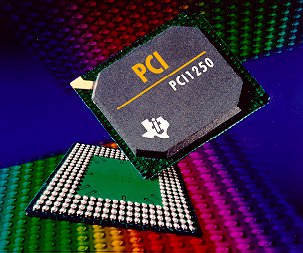
DALLAS (Jan. 6, 1997) -- Portable computers will now be able to support the most demanding multimedia applications throughout the rest of the century with the industry-leading performance of the first two members of a new family of PCI-to-CardBus controllers designed for use in high-end notebooks. The 130 plus megabytes-per-second (Mbyte/sec) speed of Texas Instruments new line of CardBus controllers approaches the theoretical 132 Mbytes/sec limit of the PCI bus, which is used in most PCs. This performance boost -- nearly three times the speed of the industry's leading CardBus controllers -- gives users the ability to run two applications, like a high-speed network and video processing, simultaneously. The innovation behind the incredible performance of this new family of CardBus controllers is a unique dual in-line FIFO architecture which gives these devices the ability to operate in a pipelined fashion. This architecture enables the controller to both receive and transmit data in two directions at the same time. No other controller can do that. Advanced Power ManagementTI's new family of CardBus controllers, designated as the PCI12 Series, was specially designed to meet the needs of systems complying with the Microsoft® PC 97 hardware design guidelines. The PCI12 Series supports PC 97's Advanced Configuration Power Interface (ACPI) requirement for complete systems. The PCI1250 allows Windows® operating systems to conserve battery life by powering down the CardBus controller when it is not in use and shutting down socket circuitry when a CardBus or PC Card is not inserted. The PCI12 Series family will function in either 3.3V or 5V bus systems. The new family of CardBus controllers also takes less of a toll on the battery life of notebook computers because it consumes approximately half the power of TI's previous generation controllers. Integrated Zoomed Video Buffers Save Board SpaceThe first device in the PCI12 Series family, the PCI1250, has integrated buffers to support Zoomed Video (ZV) on both card sockets. Previous generation devices required discrete buffers to support ZV. With ZV, video signals can be routed directly to the display to avoid saturating the motherboard PCI bus with video and audio data, and, consequently, making the PCI bus a bottleneck for high performance. The PCI1250 saves additional board space with its compact 256-pin ball grid array (BGA). Design FlexibilityThe PCI1250 includes several capabilities which simplify the task of designing a CardBus/PC Card controller into a wide range of system platforms. One such feature is TI's routing multiplexer interrupt. With this technology, designers can program the routing of a PC's standard 15 interrupt signals so that they can be output to any of several pins on the PCI1250 controller. Peripheral devices connected to the system through a CardBus/PC Card slot issue interrupts to the system's CPU to notify the system of activity. In addition, system designers can multiplex or combine more than one type of interrupt onto selected pins, increasing the design flexibility and options available to system engineers. Performance for Tomorrow's Applications"When you look at today's high-speed applications, like 40 Mbytes/sec Ultra SCSI or 28 Mbyte/sec full-motion MPEG video, you see that this new family of controllers will be able to handle high-speed I/O (input/output) for years to come," said Ed Agis, TI's PCIBus Marketing Manager. "In fact, these devices will be able to handle next generation high-speed I/O such as gigabit/sec Ethernet when it becomes available."CardBus is a subset of the PC Card 95 industry standard that defines a 32-bit credit-card-size add-in module which gives a desktop or portable computer access to peripheral devices, like modems, printers and local area networks. TI's CardBus controllers also support the older 16-bit PCMCIA (Personal Computer Memory Card International Association) specification, which is the other subset of the PC Card 95 standard. The market for CardBus cards is projected to grow rapidly over the next several years. "CardBus will be a check list item for high-end notebooks by the end of 1997. In the following year, CardBus should begin appearing in entry level notebooks and in 1999 it will be as common as PC Card slots are today," said Mike Feibus, a principal at Mercury Research, a market research firm located in Scottsdale, Arizona. Easy Upgrades
The second device in the PCI12 Series family, the PCI1220, is
packaged in a 208-pin thin quad flat pack (TQFP) package, the
same that was used in TI's previous generation CardBus and PC
Card controllers. Unlike the PCI1250, the PCI1220 does not feature
integrated memory buffers for Zoomed Video or four general purpose
I/O pins. Computer vendors that are currently using TI's CardBus
and PC Card controllers can dramatically increase the performance
of their systems without extensively re-designing their platforms
by simply upgrading to the PCI1220. Pricing and AvailabilityThe PCI1250 is scheduled to be available from Texas Instruments in the first quarter of 1997. The PCI1220 is scheduled to be available in the second quarter of 1997. Pricing in quantities of 100,000 will be $16.52 for the PCI1250 and $14.24 for the PCI1220.
Trademarks:
Microsoft and Windows are registered trademarks of Microsoft Corporation. |