|
|
Related Documentation:
Mixed Signal and Analog Products
Headlines
News Releases
Trade Shows
Search the News Archives
Reader Inquiry:
1-800-477-8924, ext. 5300
Please refer to Event Code:
MSP84
|
|
|
New 2.5V, 500mA Micro-Power Regulator Strengthens Texas Instruments Low Dropout Family
DALLAS (June 30, 1997) -- Expanding its line of low dropout (LDO) regulators, Texas Instruments (TI) introduces a new 2.5V, 500mA micro-power regulator. Featuring TI’s P-Channel MOSFET (PMOS) design, this LDO regulator is ideal in applications such as notebook and desktop computers, personal digital assistants (PDAs) and digital cameras.
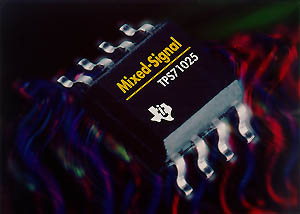
This device, designated the TPS71025, features a dropout voltage as low as 50mV at 100mA of output current while maintaining a maximum quiescent current of 292uA, regardless of load, even in dropout. This exceptional performance is achieved by using a PMOS transistor as the pass element instead of the traditional PNP transistor. Implementation of these LDOs directly adds operating life to battery-powered equipment with fixed 2.5V supplies. An enable function allows for powering down the regulator and reduces sleep-state current to 1uA.
Features/Benefits
- Low dropout voltage, 50mV
|
Extends usable battery voltage range.
|
- Low quiescent current – 292uA (typ.), independent of load
|
Prolongs battery life. |
- Low sleep state current, 1uA
|
Lengthens battery life. |
|
|
Improves system accuracy. |
|
|
Reduces component height for space-critical applications. |
End Equipment Applications
Applications for the TPS71025 include:
- Notebook and desktop computers
- PDAs
- Digital cameras
- Telecom (phones and PBXs)
- Bar code scanners
Pricing, Packaging and Availability
The TPS71025 is now available from Texas Instruments and its authorized distributors. The TPS71025 is available in a thin shrink small-outline package (TSSOP) priced at $1.11; or in a small-outline integrated circuit (SOIC) priced at $1.03, both in quantities of 1,000.
# # #
|


