


 Related Documentation:
Mixed-Signal and Analog Products
Reader Inquiry: 1-800-477-8924, ext. 5300 Please refer to Event Code: MSP92
|
New Higher-Performing PCI-to-PCI Bridge Chip is First to Conform to New Microsoft®-Required Power Management Specifications
Conforming to these standards ensures that TI's new PCI-to-PCI bridge device, which is designated the PCI2031, will support the most advanced power management features in next generation PCs, and it will be compatible with the next major release of the Microsoft Windows™ operating system. As consumers have demanded more functionality and features in their computer systems, the number of devices using the PCI bus for communication has grown. The current limit of three or four add-in card slots on the PCI bus has proven to be too restrictive in many of today's systems. PCI-to-PCI bridge chips are used to implement multiple buses within the system to support these growing requirements. The ACPI and PCI bus Power Management Interface specifications essentially transfer power management control to the operating system, thus allowing for greater functionality and flexibility in power management. "The PCI2031 provides the extendibility and performance PC vendors are looking for today for their next generation systems," said Steve Nelson, TI's Mixed Signal marketing program manager for PCIbus Solutions. "PCs need a cost-effective way to improve expandability without sacrificing performance. The PCI2031 fills this need and, when certification is received from Microsoft, will provide the added benefit of compatibility with Windows 95&153; and the next releases of Microsoft Windows and Windows NT™." Microsoft Corporation has announced that by January 1, 1998, a PC design must conform with the ACPI and PCI bus Power Management Interface specifications to be certified as capable of running the next generation Windows operating system. The PCI2031 gives system designers the assurance that their 1998 systems will comply with the latest Microsoft operating systems. TI's first-generation PCI-to-PCI chip, the PCI2030, was the first and only PCI-to-PCI bridge authorized by Microsoft to carry the Windows 95 logo, signifying the devices compatibility with this operating system. Additionally, the PCI2030 has passed compatibility testing for Windows NT. Enhancing PCI Bus Throughput With FIFO memory 50 percent larger than the previous generation device and new features like auto-reconnect, the PCI2031 can significantly improve the performance of PCI-based systems. The PCI2031 has among the deepest FIFOs in the industry for this class of device. The PCI2031’s automatic reconnect feature improves overall bus utilization for target devices, such as some chipsets, that cannot perform sustained bursting. Such devices burst large blocks of data using several discrete bursts rather than utilizing one long, continuous burst. The PCI2031 helps increase system performance and bus utilization by allowing an initiator, such as an Ethernet or SCSI controller, to reconnect to the PCI2031 when the initiator is ready to provide more data. Under certain circumstances, the auto-reconnect feature can improve bus utilization and data throughput by as much as 18 percent. Advanced Features The PCI2031 supports several advanced features not found in bridge chips from other vendors. The device supports the clock-run capability, which lowers power consumption by dynamically adjusting the speed of the PCI bus clock to conform with the operational conditions of the system. Additionally, the PCI2031 simplifies the task of bringing add-in cards into compliance with Microsoft's PC 97 specification by providing a serial interface to EEPROM memory where vendor identification information for devices on add-in cards can be stored. This eliminates the need for EEPROM on add-in cards to store this information. Availability and Pricing The PCI2031 is packaged in a 176-pin thin quad flat pack (TQFP) carrier. Engineering samples are available now from Texas Instruments and its authorized distributors. Production shipments in volume are expected to begin in September 1997. Suggested resale pricing in quantities of 1,000 is anticipated to be $14.50 per unit.
# # #
Trademarks:
|
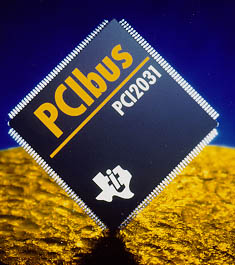 DALLAS (July 28, 1997) -- A second generation PCI-to-PCI bridge device announced today by Texas Instruments increases the throughput of desktop personal computers, workstations, notebook PC docking stations and multi-function add-in cards based on the PCI bus by incorporating new burst data transfer features and deeper first in, first out (FIFO) memory. Additionally, the device is the first PCI-to-PCI bridge chip in the industry to meet the requirements of the Advanced Configuration Power Interface (ACPI) and the PCI Bus Power Management specifications.