TI Targets End Equipments With New Logic Devices
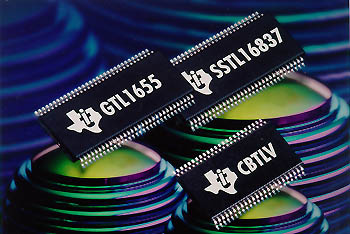
Specialized GTL, SSTL and CBTLV Products Address Key Design Needs of Telecom Backplanes, High-Speed Memory Subsystems and Notebook PCs
DALLAS (August 18, 1997) -- As part of an ongoing strategy to supply logic components for key end equipment applications, Texas Instruments announced today the development of two new logic devices and one product family. The new products are a universal bus transceiver for heavily loaded telecom backplanes; the industry's first SSTL universal bus driver for addressing SDRAMs in high-performance memory subsystems; and the first 3.3-V digitally controlled bus switches on the market.
These new products have been designated the GTL1655, the SSTL16837 and the
CBTLV family, respectively.
"By utilizing our process and technology strengths, TI is capable of addressing the logic needs of various end equipments," said Hal Speed, Strategic Marketing Manager for TI Logic Products. "These new products emphasize our strategy of providing unique logic solutions for key end equipment markets. Designers of telecom equipment, workstations and servers, and notebooks and other portable computers will find that these solutions enable them to push their systems to new levels of performance with faster speed, less power consumption and greater ease of design."
GTL1655 Universal Bus Transceiver (UBT™)
The GTL1655 UBT combines the low power consumption and high speed of Gunning transceiver logic (GTL) with the high drive of Backplane Transceiver Logic (BTL) for optimized use in heavily loaded backplanes, such as those found in telecom and networking applications. The new UBT allows designers to substitute the low-power GTL switching standard for BTL in systems requiring high-speed backplane communications without sacrificing drive capability.
With its high drive of up to 100 mA, the GTL1655 represents a milestone in the development of GTL logic. Clock speeds of 160 MHz and a maximum propagation delay of only 5.0 ns promote a high data rate. The 12-ohm, 16-bit, live-insertable device translates signals between 3.3-V
transistor-to-transistor logic (LVTTL) levels and 1.2-V GTL or 1.5-V GTL+
levels.
Additional features make the GTL1655 attractive for high-speed telecom and
networking systems. User-controllable output edge rates minimizes
high-frequency noise for greater system reliability. Bus hold on the LVTTL
ports eliminates the need for external pull-up resistors on floating inputs, helping reduce power requirements, cost and layout time for the entire design. Live-insertion capabilities support the insertion of circuit cards into a backplane while the system is operating, protecting the UBT from damage and the system from signal interruption for seamless operation on the backplane.
SSTL16837 Universal Bus Driver
The SSTL16837 is the industry's first device for driving 3.3-V address signals from a low-voltage memory controller to SDRAMs using Stub Series Terminated Logic (SSTL) technology. In designs operating at greater than 75 MHz, the SSTL16837 provides fast address signaling with minimal propagation delay. Targeted users of the device include workstations and servers initially, with eventual migration to PCs as high-speed memory subsystem technology evolves in desktop systems.
SSTL is the computer industry's leading choice for next-generation technology in high-speed memory subsystems, adopted by a JEDEC (Joint Electronic Device Engineering Committee) standard and endorsed by major memory module, workstation and PC manufacturers. The SSTL16837 converts LVTTL/SSTL signals from the memory controller to LVTTL/SSTL signals that are used by the SDRAM input pins.
CBTLV Digitally Controlled Bus Switches
The low-voltage crossbar technology (CBTLV) is the industry's first family of digitally controlled switches to combine 3.3-V operation with the switching benefits of CBT technology. CBTLV switches will become increasingly valuable to notebook PCs and other portable systems as they migrate to low-voltage operation. Designs will benefit from design simplification, reduced power requirements and support for the elimination of the 5-V power supply altogether.
Applications of the switches include PCI bus isolation for hot-docking support in current or future low-voltage systems and ACPI power management.
Availability, pricing and packaging
The GTL1655 UBT is sampling now from TI and its authorized distributors, with volume production planned for early in the fourth quarter of 1997 Planned pricing is $10.33 in quantities of 1,000. TI plans to make the device available in 64-pin thin shrink small outline packages (TSSOPs) and ceramic quad flatpacks (CQFPs) for extended temperature ranges.
The SSTL16837 universal bus driver is available now from TI and its authorized distributors in a 64-pin TSSOP. Suggested pricing is $6.00 in quantities of 1,000.
CBTLV switches are sampling now from TI and its authorized distributors, with volume production dates planned throughout the second half of 1997. A wide variety of packaging options will be available, including TSSOP and thin very small outline package (TVSOP) . Planned pricing is in the range of $.83 to $1.25 for octal switches and $2.08 to $2.92 for 16-bit Widebus™ switches, all in quantities of 1,000.
- 30 -
TRADEMARK:
Widebus and UBT are trademarks of Texas Instruments Incorporated.
|



 Related Documentation: