Industry's First 1394 OHCI Link Layer Controller and a New Family of 400 Mb/s Physical Layer Devices are Announced by Texas Instruments
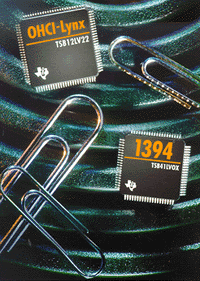 DALLAS (Nov. 10, 1997 -- Continuing its mixed-signal technology innovations, Texas Instruments, Inc., announced the development of the industry's first 1394 Open Host Controller Interface (OHCI) device and a new family of 400-megabit per second (Mb/s) physical layer interface chips conforming to the IEEE 1394-1995 and 1394. A specifications for high-speed PC I/O (input/output) subsystems. Devices, when they are introduced, will be used in desktop PCs, workstations, portable PCs, peripheral add-in cards and peripheral equipment like hard disk drives and printers.
"As one of the pioneer vendors in the 1394 market, dating back to 1994 when 1394 was first introduced, we are able to supply industry-leading components that are unmatched in performance and functionality," said Randy Trost, TI's 1394 marketing manager. "It is also very important to us that our components have a demonstrated track record of being fully compliant with the 1394 specification and its enhancement, 1394.A, as well as functioning properly with other 1394-compliant devices. These new devices will enable future digital signal processing (DSP) solution applications such as DVDs, digital VCRs and digital television."
Open Host Controller Interface
The OHCI specification is an industry standard whereby the operating system environment can communicate through a universal software driver instead of implementing an individualized driver for each particular piece of 1394 host silicon.
The new 1394 OHCI controller, which will be known as the OHCI-Lynx™, provides link layer functionality by coordinating the reception, transmission and routing of data over the 1394 bus, and managing the bus interface to memory. OHCI-Lynx conforms to the OHCI interface specification as defined by Apple, Compaq, Intel, Microsoft™, National Semiconductor, Sun Microsystems and TI, as well as the PCI bus (version 2.1) and IEEE 1394.A specifications. In addition, OHCI-Lynx meets all of the requirements of Microsoft's PC 97 and PC 98 guidelines for designing PC systems that will result in an optimal user experience with typical Windows™ applications.
The architecture of the OHCI-Lynx is based on a set of deep 8K FIFOs, which allows the device to support PCI bus master data bursts at rates as high as 132 megabytes per second (MB/s). Without deep FIFOs, high-speed data transfers from peripheral equipment, such as digital cameras or printers, might be delayed while access to the PCI bus is acquired. OHCI-Lynx is able to store data in its deep FIFOs, reducing the possibility that PCI bus latency would cause a bottleneck in system performance.
OHCI-Lynx extends the life of batteries in portable and hand-held applications by conforming to the power-saving PCI Power Management Specification. The device is compatible with both 3.3V and 5V signaling environments.
OHCI-Lynx eases the design process by maintaining compatibility with a wide range of 1394 physical layer devices capable of speeds of 100, 200 or 400 Mb/s. The device will interface directly to all of TI’s physical layer devices, including the new family of 400 Mb/s physical layer interface chips. The PC 98 guideline from Microsoft requires a 1394 physical layer device capable of 400 Mb/s transfer speeds.
Multi-port Physical Layer Interfaces
TI's family of 400 Mb/s physical layer interface chips performs the transceiver functions of initializing the 1394 communications link, arbitrating for access to the channel and actually placing data packets on the media. To meet the different needs of host PCs, hard disk drives, printers and other types of peripheral equipment, the 400 Mb/s devices in the family will offer two, three, four or six 1394 ports.
The product family features several power-saving capabilities, such as a device power-down mode and inactive port disable, that make it well suited to portable and hand-held systems. The family of 400 Mb/s PHY (physical layer) devices also conform to the Device Bay Initiative, an industry effort led by Microsoft, Compaq and Intel which is defining a standard modular design for PC chassis slots for peripheral equipment.
The 400 Mb/s PHY devices will interface directly to TI's 1394 link layer chips, reducing the complexity and cost of systems by eliminating the need for glue logic. As with other 1394 physical layer devices from TI, the 400 Mb/s family will inter-operate with other vendors physical layer devices that conform to the 1394 specification. TI's new PHY device family conforms fully to the latest enhancement to the 1394 specification, the 1394.A version.
Availability
TI is now sampling the OHCI-Lynx as well as the first device in its family of 400 Mb/s physical layer interface chips. Production volumes are scheduled to be available during the second quarter of 1998.



 Related Documentation: