Texas Instruments Announces Development Tool for Wireless Communications Systems
New Class of Wireless Tools Reduces Time-to-Market and Simplifies Product Differentiation
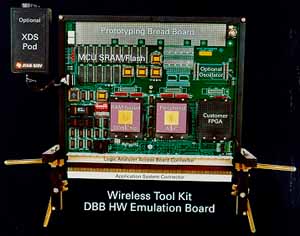
DALLAS (March 30, 1998) -- Leveraging TI's expertise in the design and volume delivery of highly-integrated, low-power digital signal processing (DSP) solutions, Texas Instruments Inc. (TI) (NYSE: TXN) today announced a new development tool that significantly cuts design cycles and reduces development costs for any wireless system using TI's single-chip Digital Baseband (DBB) solution. The development tool, which is the first product offering in TI's new class of wireless tools, can be used for digital cellular telephone handsets, base stations, wireless local loop systems, personal digital assistants (PDA) and advanced pagers.
"The Wireless Hardware Emulation Tool will simplify the design and lower the development costs of TI's DBB solution by allowing designers to begin developing differentiating features immediately without designing a prototype board," said Gilles Delfassy, worldwide general manager of the TI Wireless Communications Business Unit and Semiconductor Group vice president. "In addition, the tool will enable TI to support a wider breadth of concurrent designs in house."
The Wireless Hardware Emulation Tool, along with TI's standard-independent DBB platform, reflect the strength of the company's DSP solutions for the wireless communications market. Based on market figures from Dataquest Inc., an industry research group, TI is the leading supplier of DSPs for digital cellular telephones worldwide for the second consecutive year. "In 1997, we estimated about 84 million digital cellular phones were manufactured worldwide," said Dale Ford, Dataquest senior industry analyst.
In 1997, TI -- the world's leader in DSP solutions -- shipped approximately 49 million DSPs for digital cellular phones, more than 60 percent of the available market. In 1996, TI shipped 23.6 million DSP solutions for digital cellular phones, about half of the 48 million digital cellular phones manufactured worldwide.
"TI has gained considerable insight into the development needs of our customers over the last two years as they have developed wireless systems with our DBB platform. We have leveraged that insight into the Wireless Hardware Emulation Tool," said Sharon Phillips, product marketing for TI's DBB products. "The result is now our customers can accelerate their hardware and software development efforts by doing them concurrently. In addition, we expect that the faster cycle times enabled by the Wireless Hardware Emulation Tool will have a cumulative effect. That is, the development cycle will be reduced even more when the board is used on a second, third or fourth project."
Wireless Hardware Emulation Tool Simplifies Development of TI's Digital Baseband Platform
At the heart of the Wireless Hardware Emulation Tool is TI's DBB platform, a highly integrated DSP solution that combines the high-performance, low-power processing engine of the TMS320C54x DSP core with a 16-bit/32-bit TMS470 microcontroller core based on the ARM7TDMI (Thumb™) design. The TMS320C54x DSP core, with its 100 million instructions per second (MIPS) processing power, performs the high-speed DSP functions of wireless telephony such as speech encoding and decoding, error correction, channel encoding and decoding, equalization, demodulation and encryption. The 20 MIPS capabilities of the TMS470 (ARM7) core can be used to control the system's man-machine interface, real-time operating system, mobility and network management.
"The ’C54x and ARM7 cores were selected for the DBB because they have the capabilities needed in wireless communications systems. They provide high performance with low cost and low power dissipation," continued Phillips. "TI supports both cores, which can be accessed though an IEEE 1149.1/JTAG port for in-circuit emulation, with an extensive suite of development tools. In fact, the DBB has special proprietary logic for simultaneous co-emulation of both cores from the same emulation hardware tool. This co-emulation capability can save designers months of development time and bring products to market faster."
The Wireless Hardware Emulation Tool consists of TI's DBB device with 112K words of on-chip DSP random access memory (RAM), an application specific integrated circuit-based (ASIC) library of commonly-used peripheral modules such as timers and a serial port interface. With more than 1.5 Mbytes of external RAM and 1 Mbyte of flash memory resident on the tool, customers can simulate the future internal RAM or read only memory (ROM) code for the ARM processor. This gives developers enough memory space to develop and test embedded software before actual hardware is available. In addition, there is an unoccupied socket where designers can install an ASIC or field programmable gate array (FPGA) -- via a daughter board -- for the development of end equipment-specific differentiating capabilities.
The Wireless Hardware Emulation Tool will be used in conjunction with TI's standard development tools for the TMS320C54x and TMS470 processor cores. These development tools include a C compiler, assembler, linker and an XDS510 hardware emulator. For real-time trace capability, the tool will also connect to a logic analyzer.
A Flexible, Reusable Hardware Development Environment
Because the DBB is a completely programmable device, the Wireless Hardware Emulation Tool can be used to develop wireless systems for any region of the world using any international transmission standard, including GSM, IS-136, IS-95 and others. The large RAM array on the Wireless Hardware Emulation Tool accommodates a wide reuse of memory required for different transmission standards. The set-up time required to transition the Wireless Hardware Emulation Tool from one transmission standard to another is kept to a minimum as users are able to apply the skills they have acquired using the Wireless Hardware Emulation Tool to multiple development projects.
Roadmap to Complete Systems Solutions
TI plans to implement new versions of the Wireless Hardware Emulation Tool as new DSPs, microcontroller cores or Digital Baseband platforms are introduced. Additional hardware and software development tools will continually be made available to support the custom development of complete wireless systems. Advanced software development capabilities from TI are planned to support the implementation of next-generation systems and industry-leading features such as Internet access from wireless communication systems, multimedia applications, broadband data transmission capabilities, speech recognition and others.
Wireless Hardware Emulation Tool Kit Availability and Pricing
The Wireless Hardware Emulation Tool is scheduled to be available late in the second quarter of 1998. The tool is targeted for wireless original equipment manufacturers seeking a high level of customization to their system architecture with very high volume applications based on TI's DBB solution. Suggested pricing for the Wireless Hardware Emulation Tool is $6500. Non-recurring engineering costs and pricing for a custom DBB device varies based on each customer's specific design configuration.
More information regarding TI's Wireless Communications Business Unit and its products is available on the World Wide Web at  http://www.ti.com/sc/docs/wireless/home.htm. http://www.ti.com/sc/docs/wireless/home.htm.
# # #
TRADEMARKS
Thumb are trademarks of Advanced RISC Machines Ltd.
|



 Related Documentation: