New CardBus Controller Is First To Support New PCMCIA CardBus Power Management
Specifications
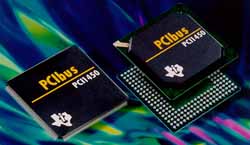 DALLAS (March 30, 1998) - A new PCI bus-to-CardBus controller that is the industry's first to conform to the new PCMCIA CardBus power management specifications, and that continues the drive toward Microsoft's® OnNow vision, was announced today by Texas Instruments. The controller will be used to interface portable computers to the credit-card size PC cards in addition to emerging CardBus applications like point-of-sales terminals, network PCs, automobiles, network routers and hubs, and digital cameras.
OnNow is an attempt to make PCs as easy and fast to turn on as standard household appliances, like a television set. It will provide instantaneous access to the computer's capabilities without going through a time-consuming boot-up process. To be continually powered in a stand-by state, the portable computer or PC must be provided very low power. The system components must also be capable of managing this low power to maintain basic functionality. For example, under the OnNow initiative a user could strike any key and the computer would immediately be fully functional without having to boot up the operating system.
TI's new device, the PCI1450, is a next-generation two-slot CardBus controller that builds on TI's leadership position in PC Card and CardBus controllers for the PCI bus. Nine of the 10 leading suppliers of notebook computers currently use TI's 32-bit CardBus controllers.
"We have always had a very aggressive attitude about bringing new technology to the PCI bus and portable computer marketplaces," said Steve Nelson, TI's marketing manager for PCIbus products. "Our leadership positions within the mobile computer industry and PCMCIA help us bring changing technology quickly to market. In doing so, we are also able to help develop the infrastructure
required in software and applications for a total system solution."
The PCI1450 features a parallel pipelined architecture that is capable of transferring data across the PCI bus at its theoretical maximum of approximately 132 megabytes per second (Mbps). Hot insertion and removal of CardBus or PC Card modules is also supported. The PCI1450 has an internal Zoom Video (ZV) capability that lightens the load on the PC's PCI bus by transferring graphic data directly to the system's graphics processor without using the PCI bus.
Native Windows Support
TI's PCI1450 development team is working to ensure that the device has native driver support from within the Windows environment. This helps ensure that drivers for the PCI1450 will be fully supported by all versions of the Windows operating system.
PCI1450 at WinHEC
The PCI1450 will be demonstrated at the Windows Hardware Engineering Conference (WinHEC) March 24-27 in Orlando, Fla. Additionally, it is under evaluation in notebook computers at several major OEMs (original equipment manufacturers), the first prototypes of which are expected by late April.
Pricing and Availability
Samples of the PCI1450 device are scheduled to be available to designers of device drivers and other infrastructure developers in July 1998. Volume shipments are expected to begin during the fourth quarter of the year.
The PCI1450 will come in a 256-pin ball grid array (BGA) package. Suggested resale pricing in quantities of 10,000 is expected to be $14.50.
More information regarding TI's CardBus products is available on the World Wide Web at  http://www.ti.com/sc/pci.



 Related Documentation: