Breakthrough CMOS Transceiver Technology from Texas Instruments Boosts Data Transfer Speeds to 2.5 Gigabits Per Second
1394, Gigabit Ethernet and Fibre Channel Stand to Benefit from New CMOS Technology
 DALLAS (June 1, 1998) --
  A new CMOS transceiver technology capable of simultaneously sending and receiving data at speeds up to 2.5 gigabits-per-second (Gbps) was disclosed today by Texas Instruments (TI) (NYSE:TXN), the world's analog and mixed-signal leader. The new technology will more than double the speed at which computer users can access and save information on their disk drives and share information across networks. For PC system, network and storage suppliers, the technology greatly advances the ability to deliver the data throughput and network bandwidth required for Internet-based computing.
Based on breakthrough design improvements including high-speed data recovery techniques and an advanced 0.25-micron CMOS process, the new technology will eventually be used in high-speed serial communications transceivers for IEEE 1394 (FireWire™), Gigabit Ethernet and Fibre Channel.
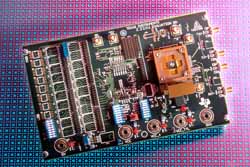
Initially, the 2.5 Gbps transceiver technology is expected to be used in discrete applications such as direct connections between hard disk drives and computers, high-speed networking backbones and backplane links between computer boards. TI currently has working prototypes of this new transceiver and has demonstrated this technology to key customers.
Previously, transceivers capable of 2.5 Gbps speeds were fabricated with exotic and often expensive processes such as gallium arsenide (GaAs) and high-speed BiCMOS. By using a standard CMOS process, the 2.5 Gbps transceivers consume less power, are more cost effective, are scalable to even smaller geometries and are compatible with other advanced processes. The 2.5 Gbps transceivers can be easily integrated with other devices such as hard disk drive controllers and the digital signal processors (DSPs) used in networking systems.
"Texas Instruments' 2.5 Gbps transceiver technology is impressive in that it provides the performance of GaAs or Bipolar, but with the power of CMOS," said Bruce Johnson, Consultant at Seagate Technology®. "This performance is apparent with Fibre Channel evaluations in Seagate® FC disc drives shipping today with data rates of 1.0625 GHz."
The first product to implement the 2.5 Gbps technology, an 800 Mbps 1394 physical layer (PHY) device, is expected to be in customers' hands by the end of the year. 1394 (IEEE 1394-1995 FireWire) is a high-performance serial data transmission solution used in computer systems and computer electronics for input/output (I/O) and on-computer system backplanes.
"By combining TI's expertise in analog and mixed-signal design and advanced semiconductor fabrication processes, we were able to push the envelope in data transmission technology," said Ed Suder, TI's Design Manager for Physical Interface Products. "In the future, we will see this technology doubling the speeds of serial data transmission techniques. 1394 PHY devices, for example, will achieve 800, 1600 and 3200 Mbps speeds, while Gigabit Ethernet will double the existing standard. And Fibre Channel will go from one to two Gbps."
Features and Test Capabilities
The 2.5 Gbps transceiver technology will operate off of either 2.5V or 3.3V power supplies, and will scale to lower voltages. The transmission media for a 2.5 Gbps transceiver can be a printed circuit board backplane, copper cables or fiber optic cables.
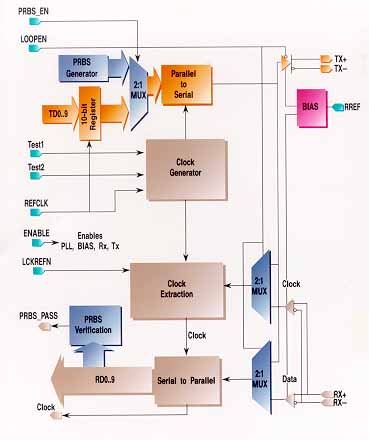
The new transceiver technology includes several on-chip advanced test techniques, which eliminates the need for separate test equipment. These techniques can be used for both functional system tests and manufacturing test procedures.
In addition to an internal loop-back test, the 2.5 Gbps transceiver technology also includes a pseudo random bit stream (PRBS) generator that can be used to perform several types of tests, including built-in self test (BIST) for all of the circuitry on the device. Additionally, a 2.5 Gbps transceiver can generate a PRBS and transmit it to a bit error rate tester (BERT) to verify the accuracy of its transmit function. All of these tests can be performed at the maximum speed of the device.
In addition to ongoing customer demonstrations that show the full speed of the transceiver, the 2.5 Gbps CMOS transceiver technology will be demonstrated at the 1394 Developers' Conference in the form of IEEE-1394.b, S800 and S1600 data rates. The conference will be held June 29-July 1 in San Jose, Calif.



 Related Documentation: