


 Related Documentation:
Mixed-Signal and Analog Products Industry's First LVDS Dual Driver/Receiver Devices Extend Reach of New Data Interface Standard Profiles of Today's Data Transmission Standards
Reader Inquiry:
1-800-477-8924, ext. 5300 |
Industry's First LVDS Dual Driver/Receiver Devices Extend Reach of New Data Interface Standard
Texas Instruments Expands LVDS FrontierDALLAS (Aug. 24, 1998) -- Low Voltage Differential Signaling (LVDS) technology can expand into new applications with the introduction of the industry's first LVDS dual driver/receiver devices. Texas Instruments (TI), the world leader in analog and mixed-signal products, announced four new devices today, bringing its LVDS product portfolio to 17 devices -- one of the broadest offerings available in the market. TI has more than 30 years of leadership experience in implementing data transmission standards -- from RS-232 to IEEE 1394 to LVDS. "More and more designers are looking to LVDS as a solution to data transmission applications requiring high speeds, low power consumption and low noise," said Steve Goacher, new product development manager for TI's Advanced Analog Products. "Dual driver/receiver devices will allow designers to implement LVDS solutions in new applications -- ones that use synchronous serial buses like point-of-sale terminals." LVDS Technology LVDS technology addresses point-to-point physical layer interfaces. These include intra-system connections such as printed circuit board traces and cables. Physical layer interfaces are often a critical bottleneck in any application that requires high bandwidths -- telecommunications and high-speed networking, for example.
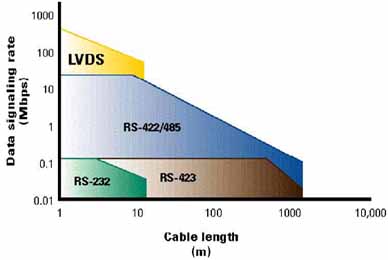 LVDS is a new data interface standard based on the TIA/EIA-644 and the IEEE 1596.3 standards. LVDS achieves signaling rates as high as 655 megabits per second and consumes as little as one-eighth the power of RS-422 drivers. More about LVDS technology and how it works can be found in the accompanying editorial backgrounder entitled "LVDS Technology: The Basics." New LVDS Devices TI's dual driver/receiver devices are designated the SN65LVDS050 and SN65LVDS051. Both devices contain two drivers and two receivers. The 'LVDS050 comes with an enabling scheme that allows the designer to operate only the drivers, only the receivers or all the drivers and receivers. The 'LVDS051 comes with an enabling scheme for the drivers only. The designer can choose to operate both drivers or only one driver -- in addition to the two receivers onboard. In addition to the dual driver/receivers, TI also announced the SN65LVDS179 and the SN65LVDS180, each of which has a single driver/receiver. The 'LVDS180 also comes with an enabling scheme that allows the designer to use the device as a single driver, a single receiver or as a driver and a receiver. The four LVDS devices have ESD protection of more than 8kV on the bus pin. The devices operate off of a single 3.3V power supply, but are tolerant up to 5V on the I/O pins. They feature a driver propagation delay of less than 2.5 nanoseconds. Each receiver supports open-circuit fail safe to prevent noise from appearing as a valid signal. These four devices are scheduled to be available in fourth quarter 1998 from TI's authorized distributors. TI's LVDS Development Tools TI's LVDS product line is fully supported with documentation and evaluation tools. TI offers a Data Transmission data book to help designers select the appropriate LVDS device. The LVDS Designers Guide offers advice for effectively implementing an LVDS solution. Application notes offer designers solutions to their design challenges. In addition, evaluation modules (EVMs) are available to help designers evaluate TI's LVDS products. TI's LVDS Product Portfolio TI now offers 17 LVDS devices through its authorized distributors. This product portfolio offers designers a variety of footprints, allowing them to choose the configuration that best fits their design application. The devices are detailed in the following table.
Notes:
Trademark:
|
||||||||||||||||||||||||||||||||||||||||||||||||||||||||||||||||||||||||||||||||||||