|
Wireless Communciations Introduction to Wireless Wireless Solutions Literature
Wireless Terms
|
TI and Java™: Bringing the Revolution in Network Intelligence to Wireless SystemsThe Challenge of the NetworkWireless service providers today are faced with enormous opportunities for the future -- and enormous challenges. Demand for wireless services continues to grow rapidly, with estimates of as many as 425 million subscribers around the world by the year 2000. At the same time, an increase in capacity, coupled with an industry trend toward deregulation, is forcing service providers to compete more vigorously for subscribers.Greater wireless capacity results from two factors. First, with the addition of the Personal Communication Systems (PCS) frequency band to the existing cellular band, more of the radio frequency (RF) spectrum is now available for wireless telephone communications. Second, digital transmission, which is growing in cellular services and is used exclusively with PCS, allows the spectrum to be used more efficiently. The result is that service providers can carry more voice calls in the same bandwidth, and they can open channels with larger bandwidth for new data services in PCS networks. Data services offer service providers a possible way to differentiate their offerings in the highly competitive wireless market. Digital transmission provides the infrastructure for data and even multimedia information to be transmitted along with voice. Subscribers who have grown accustomed to Internet and other data services on wired networks are now beginning to anticipate having the same capabilities on wireless networks. New data services tend to complicate a market that is already entangled in dual cellular and PCS frequency bands, multiple analog and digital transmission standards, and the continual upgrading of both standards and add-in features. Service providers must determine which capabilities their handsets will support, and at what cost. Since telephone handsets are often given away or sold at a nominal price to encourage service subscriptions, they need to be as cost-effective as possible. Unfortunately, changes in standards and optional features tend to outdate existing handset units quickly, forcing early replacement of units and diminishing economies of scale. New data services will tend to exacerbate this problem unless a means can be found for introducing them cost-effectively. Creating New Wireless Market Potential
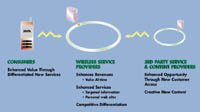
Distributing network intelligence through Java simplifies updates and enables new service offerings, creating opportunities for new markets in the wireless industry. The Value of ProgrammabilityExperience shows that service providers will turn to original equipment manufacturers (OEMs) for handsets that are designed to simplify the process of upgrading. The obvious solution is to make maximum use of programmability, which will allow units to be upgraded through a simple change of code. The strategy of reprogramming is already in use for handset development, where TI's programmable digital wireless baseband solutions provide OEMs with the means to make design changes quickly and cost-efficiently with software, rather than expensive hardware redesign.The challenge that faces TI and its wireless customers is how to extend this capability to handsets that are already in use. To be most cost-effective throughout its lifespan, a unit must be reprogrammable while it is in the field -- in the user's hands, wherever that may be. While the digital signal processors (DSPs) and microcontrollers that TI supplies can support field reprogramming, the wireless industry still needs a standard interchange mechanism for transferring programs and data. Today such a mechanism is either unavailable or, at best, limited and proprietary. However, there is a widely recognized solution that will be implemented in the future for providing new programs through the wireless network. It is called Java. A New Software ParadigmJava, created and developed by Sun Microsystems, Inc., has introduced a new software paradigm to computing. Systems no longer have to contain all of the software they use; instead, they can receive code through the network. Using Java, mobile systems such as wireless handsets can increase in functionality but remain "thin"; that is, they will not need disk drives or large amounts of firmware in order to store numerous programs. Thin handsets can also be updated through the network -- an important advantage in the highly competitive wireless industry.Providing the capability to manage a system's software library by reprogramming on the fly is only one of the advantages Java brings to wireless instruments. In addition, Java enables service providers to make full use of the power of digital communications for bringing greater functionality and user appeal to wireless applications. Some of the applications that Java will make more readily available include voice mail, access to the Internet or enterprise data bases, global positioning, traffic assistance, and many other forms of voice and data communications that can be activated by either keypad inputs or speech recognition. Real-time multimedia applications such as videoconferencing are also possible in succeeding generations of equipment. While these applications could be implemented as proprietary, custom developments, they would carry a high price tag and would be unlikely to be interoperable among hardware platforms. The standard platform definition that Java provides is key to the widespread development and deployment of mobile applications by third-party software vendors. The availability of third-party software will, in turn, simplify implementation for service providers and stimulate the market for new services and the use of wireless airtime among users.
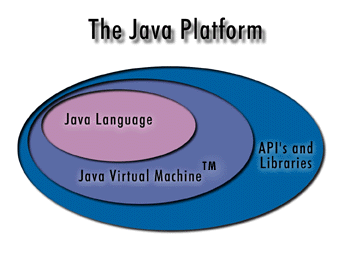
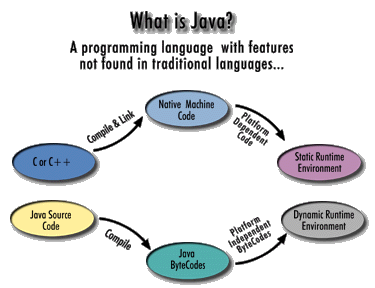
Java as a Solution for WirelessJava has already demonstrated many advantages for the Internet and other wired networks, but its real impact is only beginning to be felt. As Java migrates to embedded, often mobile systems, it will enable them to perform many functions that they could not perform previously. Overall network intelligence will grow rapidly, and individual networked devices will learn how to behave in diverse roles.At the heart of the Java Application Environment (JAE) is an object-oriented programming language with a procedural syntax that is similar to the widely used C programming language. Java programs are compiled into an intermediate format known as Java byte codes, which can either reside in the system or be stored elsewhere in the network in a downloadable form known as an applet. When a Java applet is invoked, it travels over the communications link to the remote system, where it is verified and stored, then interpreted one byte code at a time to run the application. The Java Virtual Machine (JVM)™ or interpreter is the main part of the environment that permanently resides in remote systems. The small size of the language keeps the JVM compact, and the byte code representation of the program is more concise than a compiled version would be in assembly code. For the relatively small amount of memory that is dedicated to the Java environment, a system gains immense flexibility. Instead of having to store a vast number of compiled programs in memory, the system can simply download and use the applets it needs at a given time, then either discard them or retain them for later use. To reduce storage requirements in smaller, resource-limited systems, subsets of the complete Enterprise Java™ environment have been defined. TI has licensed from Sun the right to include the Personal Java™ and Embedded Java™ environments in any of its microprocessors. These devices include TI's industry-leading TMS320 DSPs, as well as its TMS470 microcontrollers, based on a 32-bit RISC design licensed from Advanced RISC Machines (ARM™). These upwardly compatible JAE subsets, which are tailored to the needs of consumer electronics and embedded systems, will bring new programming flexibility to mobile applications such as wireless handsets.
Java is
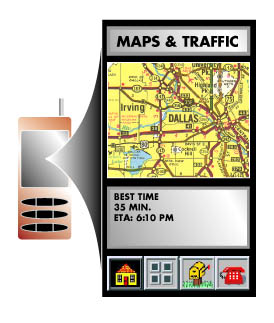
Architecture NeutralityJava is designed to be architecture-neutral, so that the same byte code can be run by any microprocessor on any platform that has a resident JAE. The only restriction is that the JAE of a system can only handle the subset of the language that it is designed for. For example, Personal and Embedded JAEs will ignore the more complex graphics instructions that are supported by the Enterprise JAE. This "write once, run anywhere"™ feature distinguishes Java programs from those written in other computer languages, which exist in different versions for different systems.Architecture neutrality means that programmers do not have to be familiar with the underlying architecture of the systems for which they are developing code. A uniform application programming interface (API) for each JAE helps simplify the creation of applets for the large and growing body of Java programmers. Service providers benefit because they can create their own applets easily and because third-party developers can quickly create off-the-shelf Java applications to support the industry. Programmers can also build on the legacy of Java applets for desktop applications. The same software code can be reused on Java-enabled instruments manufactured by different OEMs, simplifying reprogramming and maintenance operations for service providers. Code reuse is also attractive because it boosts the productivity of programmers, who are free to go on to new projects instead of adapting their programs to new platforms. Finally, since Java supports dynamic linking, a single instrument can receive different modules of the same program from different sources, giving service providers flexibility in the way they implement Java applications within the network. Reliability, SecurityReliability and security are major concerns in the wireless industry, and Java is superior in both respects. During code deployment, the JVM supports runtime checking so that there is minimal risk to the system. If errors slip into applet code, Java's exception handling keeps systems operating as smoothly as possible. Java's security system prevents applets from accessing files or directory structures on local systems, making the JAE inhospitable to viruses. The Java language eliminates some of the features that have proven to be error-prone in other languages. For instance, Java does not support memory pointers, so that the operation of each applet is restricted to its own area of memory and is prevented from accessing data outside its boundaries. All of these factors assure service providers that Java is both reliable and secure for use in their networks.Processing RequirementsNo advance comes without a price, and in the case of Java this price is the need for greater performance and, indirectly, more data memory. Fortunately, advances in integrated circuit technology will more than make up for these demands.Since interpreted programs like Java applets take more time to run than compiled programs, microprocessors must provide additional MIPS (millions of instructions per second) in order to make up for the slower program execution. TI has tailored the DSP and microcontroller in its wireless baseband solutions so that they operate extremely efficiently, with MIPS to spare after handling the essential wireless transmission algorithms. Advanced manufacturing processes ensure that every new generation of TI's wireless solutions provides a higher level of performance with lower power consumption. Wireless handsets based on these devices will be able to execute Java at a speed that users will welcome for non-real-time tasks such as Internet and data base accesses. Real-time tasks such voice encoding and compression will continue to operate from faster compiled programs with occasional updates using Java as a software library manager. In addition, Java will give applications programmers access to the communications and media processing power of DSPs, helping them build new applications that are tailored for wireless systems. Memory RequirementsAlthough Java itself is relatively compact, it will require some additional program memory beyond the requirements of the dedicated operational programs in the system. The new capabilities that Java enables may also require additional data memory for the execution of voice mail, small graphics displays, videoconferencing and so on. However, if all these programs were loaded permanently, a system's program memory would be enormous. Java will give systems vastly greater program flexibility at the cost of a small increase in memory size.Even with this increase, future generations of wireless products are unlikely to require more memory chips. As in the case of DSP and microcontroller performance, advances in integrated circuit technology continue to make more memory storage available in less space at a comparable cost. All in all, reduced silicon geometries and higher levels of system integration will mitigate the increased memory size required by Java. How Network Services Will Use JavaJava lends itself to two different kinds of applications, plus a third approach that is a hybrid of the others. First, Java will serve as a software library manager that upgrades or adds to the existing functionality of a cellular or PCS instrument through downloads of compiled code. Examples include voice encoding and compression algorithms, digital noise filters, transmission protocols, speech recognition for voice dialing, and many other types of programs that run in real time. These types of programs will satisfy the need of service providers to upgrade units efficiently in the field.Second, Java opens up possibilities for service offerings that do not need real-time response. These services may be based on programs that operate entirely as self-contained Java applets. Accesses to voice mail, email, directory service, data bases and the Internet suggest themselves as candidates for this type of program, as do location services that help users determine travel routes or find addresses. Finally, some services will utilize a hybrid approach, in which a compiled program is downloaded, then activated by a Java applet. Multimedia programs, for instance, will almost certainly benefit if some of the program is resident on the local system and running in real time. Wireless instruments are already changing to accommodate new types of service offerings, as larger displays with more graphic capabilities are beginning to appear. Wireless phones, or the more aptly named personal communicators, will be able to display Internet pages or images from remote cameras. Salespeople will be able to meet their clients face-to-face via videoconferences, even when they are miles from the office. Anxious parents taking an evening out will be able to see the baby sleeping. Motorists lost in a strange city will be able to consult a map. These and countless other uses will be available to wireless subscribers. The possibilities are limited only by the imagination of programmers and service providers -- and the demand of users.
Enabling New Types of Services
TI and the Revolution in Network IntelligenceAmong component vendors for the wireless industry, TI has distinguished itself by providing highly integrated solutions that help OEMs minimize costs, reduce size and power consumption, and enhance the quality of their products. TI's success in meeting its customers' needs is shown by the fact that TMS320 DSP solutions are used today in more than half the digital wireless telephones produced worldwide.A Comprehensive DSP Solution for Wireless Systems
TI's modular wireless digital baseband platform is the
core of a comprehensive DSP solution for wireless systems supporting all
major digital wireless standards worldwide. TI supplies solutions for
Since system requirements vary greatly from region to region, TI has developed a modular hardware/software platform that is consistent across market segments. The platform integrates all of the digital functions required by the digital baseband subsystem of a wireless phone, including the TMS320C54x DSP core, RAM, ROM, application-specific logic, and the TMS470 microcontroller core. In addition, TI is also supplying system software such as GSM Layer 1 software blocks, and many of the necessary vocoders (EFR, FR, HR). Complementing the digital baseband platform are a range of mixed-signal and analog products, including the analog baseband voice and RF interfaces, power management devices and planned components for the RF subsystem. OEMs of cellular, PCS and cordless phones, as well as advanced paging and messaging systems, all benefit from TI's modular approach, since it supports differentiation and helps reduce time to market. On top of TI's growing platform of digital baseband hardware, system software and transmission software, the company is now adding Java capabilities. TI recognizes that service providers are increasingly adding value to their offerings through new features and applications. Java-enabled systems will provide the means to combine voice, data and multimedia applications in the same instrument for enhanced service capabilities. Java's portability will enable OEMs to reuse code and get their products to market sooner. And Java's use as a software library manager will help keep handsets in service longer by assisting in remote updates of essential software. Bringing Greater Value to Wireless Systems
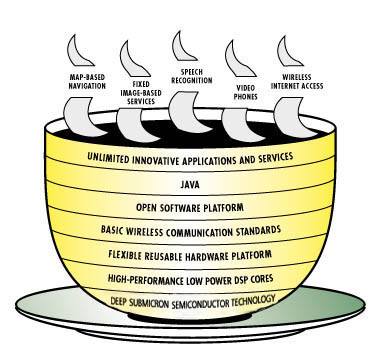
As the latest addition to TI's software platform, Java will enable OEMs, service providers and third parties to develop new applications that add even greater value to systems for end users.
Complementing TI's Wireless BusinessTI's Java strategy extends beyond licensing. TI participates actively in industry standardization activities that affect wireless telephony, including a committee working to define a Java speech API. TI also participates on several other industry standardization committees including CDMA Development Group (CDG), Universal Wireless Coms Consortium (UWCC), ETSI, TIA and CTIA.Through its highly focused Wireless Communications Business Unit, TI works closely with major OEMs and service providers worldwide in order to understand how end user applications affect system requirements. TI's long association with these customers has resulted in a high level of systems expertise that makes it possible to design components more closely matched to market needs. Results of this close association include not only the licensing of Java, but also the ways in which TI implements support for Java in its DSP and microcontroller cores. A World of OpportunityAs service providers look into the future of their industry, they perceive the need for faster, more cost-effective ways of responding to changes in standards and customer demand. The Java environment offers an ideal tool for keeping systems in the wireless network up to date. At the same time, it opens a world of opportunity for adding interactive data and multimedia applications to voice, giving service providers the means to create new services that will stimulate demand for their businesses.Today TI is implementing Java in its DSP solutions for digital wireless systems. In the near future, wireless OEMs using TI solutions will be able to create products that can be upgraded in the field. The same products will give service providers the means to enhance their offerings with new applications, which in turn will offer end users new capabilities for remote communications. The incorporation of Java into the TI wireless platform is one of the ways TI is bringing the revolution in network intelligence to the wireless world.
TRADEMARKS ARM is a trademark of Advanced RISC Machines, Ltd. |