


Making Wireless Work In The New CenturyThe changing landscape of our industry will drive new demands for multi-mode as well as multi-band telephones. Today, we are already seeing combination analog and digital phones. Tomorrow, wireless users will want phones that work on any standard to accommodate them when they travel or to get them the best rates available in town. 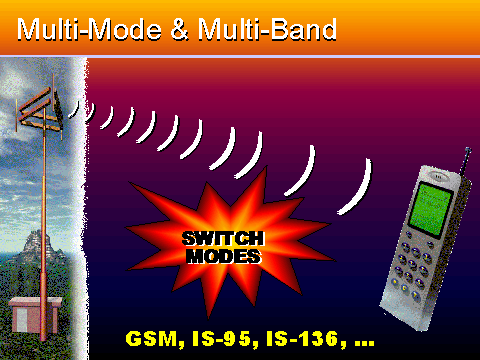 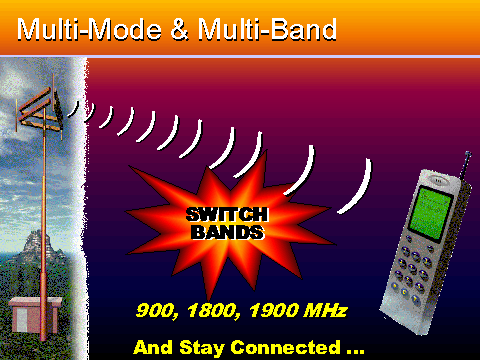 They will also want multi-band units: Phones that can switch to the optimum frequency, so that the end-user can stay connected, whether he is in his car...at home...or heading to an appointment in an office building. In addition, future applications will include some type of multimedia. Service providers should be pleased to use these value-added services as a way to differentiate their networks. These services will provide end-users with the functionality they want. And the good news for us is they will be ready to pay for it. The challenge is this functionality will require greater bandwidth...not to mention, much greater demands of processing power. In fact, it is clear that the current generation of wireless systems is not up to the task. Today’s digital cellular standards are implementing the kind of demands we expect to see develop over the next five years and will drive a massive utilization of data services which would simply saturate those networks. We are all familiar with the development, the battle and, recently, the compromise of Third Generation wireless standards. These systems will move very quickly from the standards committees...to field implementation over the next several years. Third Generation candidates do promise to carry the load. Although no one really knows which Third Generation system or systems will emerge as the dominant technology, it seems likely that we will continue to have three competing technologies to deal with as we go forward. Picking the right wireless standard investment is a little like wrestling with clouds: Every time you think you have got a good grip on the market’s direction, it just slips through your fingers. But I think it is safe to predict that the keys to success for any new investments will need to revolve around qualities like flexibility...scalability...and programmability. 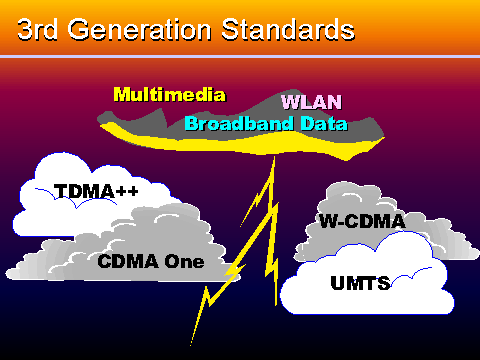  Why are those qualities so important? Because, as we discussed earlier, the very definition of wireless service is changing. It is not a voice technology any more. It is becoming much richer, with service definitions as varied as the millions of people who use the wireless networks to keep in touch. In a very real sense, wireless is following the same path that we have seen take shape in the computing market. Twenty years ago, the computer business was characterized by big centralized units...and a one-size-fits-all approach to services and applications. 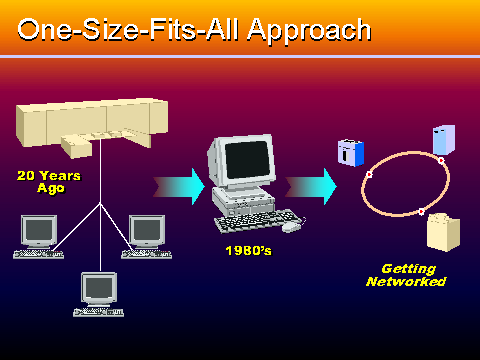
In the 80s, centralization began to give way to a more distributed approach: We saw the growth of personal computers...as processing power moved out of the computing center, onto the desktop. Then, in more recent years, the evolution has continued. We have seen the birth of networked computing. PCs do not stand alone any more. They are all getting connected, via modems and local area networks. And as that trend has taken shape, it had a profound effect on the way people use their information technology. Applications like file-sharing...groupware...and e-mail now make it possible for people to work in entirely new ways, to collaborate more effectively. And every day on the Internet we discover new emerging concepts. You do not have to settle for one-size-fits-all solutions any more. You can personalize your information technology...you can optimize your systems...by downloading applets that give you precisely the functionality you are looking for, whenever you happen to need it. The same trends seem to be taking place in wireless communications. Just like the computer industry, Everything started with a centralized telecommunication then it moved a few years ago to personal communication and we see in front of us the connection of our wireless communicators to networks allowing each of us to adapt our phone to our specific needs. 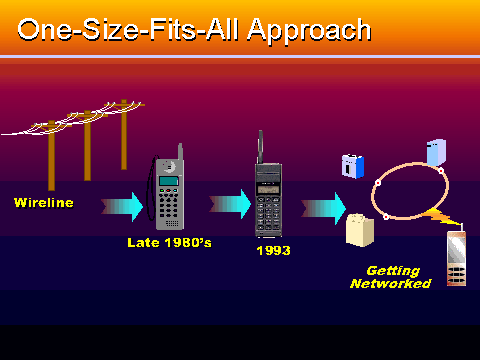
That is why qualities like flexibility and scalability are so important. Computer users already have it. And if we are smart, we will design our future wireless systems and end-equipment to deliver the same variety of advanced features and applications for tomorrow’s wireless subscribers. This approach is crucial to the industry’s growth and development. It will help to keep wireless responsive to the many emerging needs of end-users...and it will create many new opportunities for service providers and OEMs to differentiate. The reason should be obvious. If wireless customers have access to a multitude of differentiated services, then their usage will increase. Service providers will be able to keep their businesses growing...by offering advanced services that go well beyond voice. The system operators will not necessarily have to develop such services. In fact, it is more likely that they will be developed by people who are close to the needs of a specific market. A niche player in South Africa, for example, may develop a service or application specifically for the needs of that country. In the health care field, other developers may well create services designed specifically for doctors or hospital administrators. No doubt, some companies will develop applications for special interest groups, too — a set of services for senior citizens, perhaps. Or a GPS satellite application for people, like me, who enjoy sailing on the weekends. These services will vary from market to market. The range of services will no longer be defined by communications standards...but by the particular needs of a group of end-users. 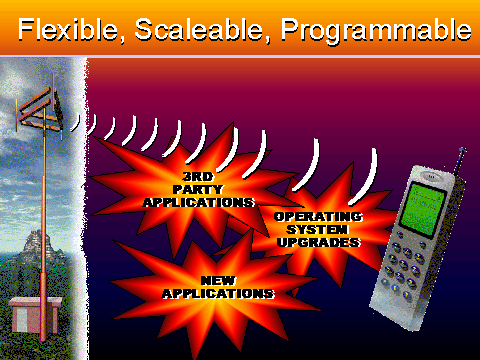
Future applications will create new opportunities for OEMs, too. They will have to design and market powerful new devices which are capable of supporting tomorrow’s advanced services. They will be able to offer a much broader range of phones and information devices, to suit the needs of many more wireless subscribers. These new application developers would also benefit from this new, more flexible and more scaleable approach to systems design. This is essentially a new group of people who are creating entirely new applications, often for niche markets, that can be delivered over wireless networks...much the way Java applets and shareware are being distributed via the Internet today...or perhaps new features that can be bundled with the phone at the OEM production level. These content providers are a critical part of the mix. We believe they can bring an unprecedented level of creativity and innovation to the wireless market. That is why TI is investing $100 million in a technology development fund...to encourage such third-party players to develop new applications for DSP technology. We expect third-party developers to help break the industry out of its one-size-fits-all mindset. They will push the market in exciting new directions...and create an ongoing stream of innovative services and applications along the way...because they understand the needs of specific end-user groups and markets. This is an exciting approach. But in order to make it happen, all the players involved — from the service providers...to the OEMs...to the third-party developers and the semiconductor suppliers — will have to embrace a common vision about what wireless can become. We will have to be open to new ideas. We will have to have foundation blocks in place that will allow, and encourage, innovation to occur from many different directions...and at many different levels...within the wireless industry. For our part, Texas Instruments is already working toward that goal. I mentioned earlier that we have a model in mind for the end-equipment side of the business. Our model is based on a combination of high-performance DSP hardware platforms...and the software platforms which provide the flexibility and application interfaces needed to continuously improve their functionality. Let us take a closer look at how this model will work...and why it makes sense for tomorrow’s wireless environment. 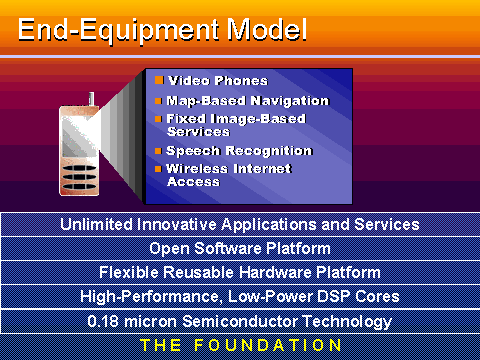
To begin, the combination of DSPs and software already provides a strong foundation for the development of tomorrow’s wireless features and applications. Take the need for agile communications, for example. We talked about a future where users may encounter multiple transmission standards during the course of a day. By implementing most of the baseband in the DSP software...and by changing this particular piece of the software...you can switch the phone or information device to work on different standards. The same thing may become true with respect to radio frequency. OEMs have always relied on hardwired RF solutions in the past. But software may provide a better answer. If you can raise the frequency limit of the DSP and its analog converters, then there is less need to change out chips...or duplicate hardware. Simply by changing the software, you can make a single DSP solution work in a number of different environments...and you can minimize the number of RF chips to be replaced or duplicated. Digital signal processors are well-suited for the demands of multimedia processing that will be placed on tomorrow’s phones. To deliver high-quality voice, for example, you need top-notch voice coding algorithms... and typically, a lot of MIPS. DSPs are the perfect way to get the job done efficiently.
Speech recognition is another key future requirement. In fact, it’s happening right now in Europe, where you are not allowed to use a phone while you are driving. Here again, DSPs are the best way to get the processing power you need to make speech recognition happen. 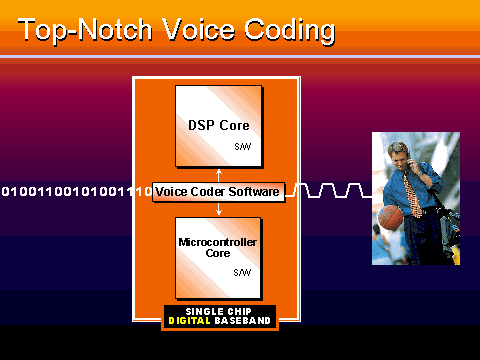
As for image and video applications, these were among the first uses of DSPs in the 80s...so the technology is very much capable of providing that type of functionality in tomorrow’s phones. And finally, as soon as you connect to a data network, security becomes an issue. Typically, encryption codes involve a lot of math — and that is again something the DSP does pretty well. When you consider all of these performance requirements, you can see why we believe the DSP will be a cornerstone technology for tomorrow’s wireless phones and information devices. In addition, we believe it is absolutely critical to have a software platform, on top of the DSP, that will provide virtually unlimited flexibility for the development of future applications. The kind of platform we envision would involve a number of elements. • First, we are building a real-time operating system that will manage the activity of a range of component-based software elements.
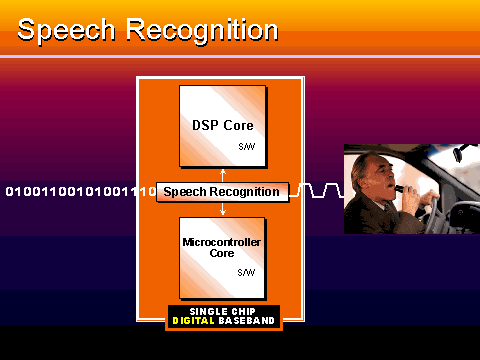
• As there is no need to re-invent the wheel, it would feature a library of standard applications, for must-have capabilities such as speech recognition or video processing. • And it would offer a good set of development tools, so that content providers and third-party developers can turn their good ideas into workable applications sooner than later.
Based on this software platform, the wireless device will be able to receive code "on demand," through the network. That capability will provide a number of advantages for future generations of wireless end-equipment. It means tomorrow’s phones and information devices will be able to deliver increased functionality, but without increasing in size. In addition, as standards evolve...or the end-user’s requirements change...it will be possible to upgrade tomorrow’s handsets automatically, through the network. Back in the early ‘90s, we made our first inroads into the wireless market by introducing a DSP core, optimized for the needs of digital baseband processing. Since then, we have continued to push the envelope on DSP chip architecture...leading up to the introduction, 14 months ago, of the industry’s first single-chip DSP engine for wireless phones: Our chip integrating the DSP core with the microcontroller core in an ASIC backplane which is now in full production. It is not much of an exaggeration to say that this single-chip engine created a whole new space in the end-equipment marketplace. It is the enabling technology behind today’s best digital cellular phones. We have also been doing extensive work on the analog baseband. We offer a single-chip solution that interfaces the RF and voiceband analog world to the digital world of the DSP. In both cases, with the analog baseband and the digital baseband, we have created a very flexible, hardware platform — a platform that relies on software to provide the agility to handle a wide range of end-use requirements. 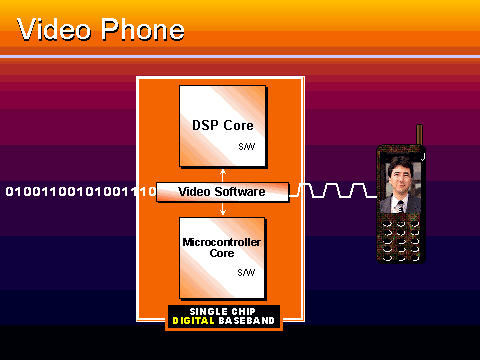
As we look ahead to future wireless equipment, it seems clear that this sort of flexible, reusable platform will become even more essential. And we do know that OEMs want to accelerate their product development efforts even faster. In the past, digital cellular phone makers tried to introduce a couple of models per year. This year, some of our customers say they are planning to launch eight models. To make it happen, they will need to be able to re-use their hardware and software modules. They will not have time to start from scratch on every new model. So it only makes sense to build on a foundation that is as robust and scaleable as we can possibly make it. When you marry this component-based software platform...with the high performance number-crunching power of the DSP...you can see the benefit: It leads to an unprecedented level of flexibility...scalability...and programmability for tomorrow’s wireless phones and information devices...while also keeping them extremely portable, efficient and affordable. Very quickly, we expect our technology platform to enable a wide range of exciting new services and features for wireless subscribers. Here is one possible example: A "best route" personal mapping service. You simply tell the device where you are...and where you are headed. Then comes on the screen a personalized map. 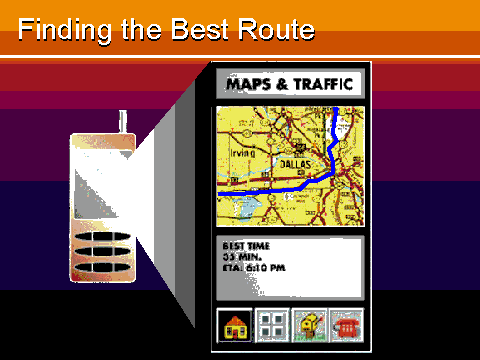
Another possible application could be the "wireless watchdog": a home security applet that lets you receive alarm warnings...perhaps monitor the baby Of course, these types of services are just the tip of the iceberg. The real magic starts to happen when we move beyond such classical services, and zero in on the even broader universe of unknown niche applications. Instead of a market built around "one-size-fits-all" wireless solutions, we will begin to see services...and service configurations...that are very much tailored to the needs of individual subscribers. The possibilities are endless. But in order to turn those possibilities into profitable new businesses, we have to start by recognizing that this variety of demand exists. We have to anticipate the need for flexibility and scalability...and then, design programmable technology platforms to match. Our goal should be simple: To adopt technology strategies and standards that put no limits on the number and type of value-added services which can emerge over the next decade. 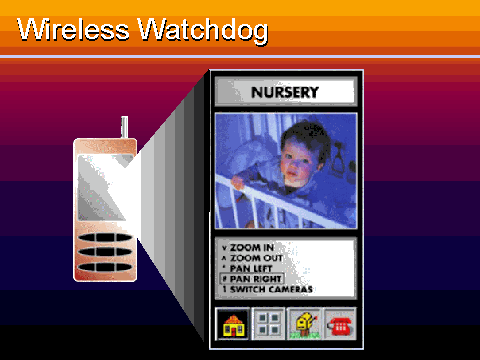
Obviously, that is easier said than done. It will require that the industry make unprecedented improvements in network quality...in bandwidth utilization...and in end-equipment performance. It will require, too, a new level of openness with respect to the sources of innovation. No one player...or group of players...has what it takes to get the job done on its own. Not the service providers. Not the base-station and network designers. Not the OEMs. Not the semiconductor industry. Not the third-party developers and content providers. But if we work together, we all stand to benefit. Individually, none of us is capable of developing and launching all the systems and platforms needed to enable the next generation of wireless service. Individually, none of us can justify the risk of making all-or-nothing bets on a particular approach to the network of the future. Instead, we should be thinking about open systems and platforms — platforms that will allow, and encourage, others to contribute to the continued development of the wireless marketplace. In our view, the industry cannot afford to assume that such openness will take shape on its own. We do not want to leave it to chance. That is why we participate actively in organizations, such as the TIA, ETSI, MIPS, W.A.P., UWC, CDG, ARIB which are working to promote the inter-operability of next-generation wireless systems and applications. These organizations, are important. But whether or not we take advantage of such opportunities, what is really crucial is that we move quickly and decisively to embrace a vision for the future of wireless...and start to make it happen. Many of us are already developing and implementing our Third Generation strategies. That is great. But I think we can go much faster... and we can push the limits of technology much farther...if we all agree to think in terms like flexibility...scalability...and programmability. 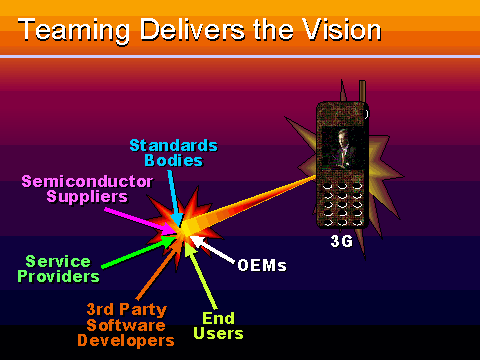
In fact, nothing could be more important for the future of our industry. Why? Because the faster we move, the better our prospects become. The faster we deliver the bandwidth, and the value-added services to run on them... The faster we introduce next-generation end-equipment, and the semiconductors that will power them...the better off we will be. The better we will be able to make our products and services a mandatory part of tomorrow’s lifestyles. This way, we will prevent our market to collapse in a "consumer or commodity" type spiral where the value disappears. If we are smart about the way we approach our opportunities today, I am convinced we will be setting the stage for an era of unprecedented growth in wireless. And that is saying something. After all, this is the industry that grew five times faster in the 80s...and 15 times faster in the 90s than wireline did over its first seven decades. Certainly, we can be proud of our track record. But as far as we have come, we have a chance to ensure that our best days still are ahead. I, for one, am excited about the prospect. I hope we all are. And I encourage you to use this Symposium...and other opportunities like it...to keep the ball rolling toward a future without limits. It’s within our grasp, as long as we all do our part to support and strengthen that vision. Thank you for listening...and have a great conference! # # # |