|
Wireless: A view from 50,000 feet
By Mike McMahan, TI Fellow
Wireless is the largest, fastest-growing digital
signal processing solution market segment. This wide-ranging communications
medium can refer to any system that facilitates communication,
either person-to-person, person-to-machine or machine-to-machine
without wired connections. It can support both voice and data
for either local or wide area applications.
Here is a summary of the wireless communications
market. A complete technology overview about the industry is available
on TI's wireless home page, www.ti.com/sc/docs/wireless/home.htm.
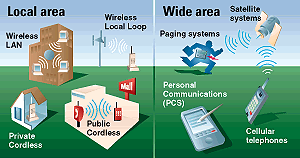
Local area
- Private Cordless is the class of systems most
of us have in our homes. It uses the 46/49 MHz band to communicate
at very short ranges. One trend is to replace these old analog
systems with digital spread spectrum technology that can provide
greater ranges with higher security.
- Wireless Local Area Networks today provide up
to 2 Mbps at short ranges within homes or office buildings. These
systems generally use spread spectrum technology and proprietary
standards operating in unlicensed frequency bands (2.4 or 5.6
GHz). Recent development of standards in the United States and
Europe (802.11 and HyperLan) combined with the surge in Internet
applications may energize this small market.
- Public Cordless systems provide local area service
using digital standards (PACS, DECT or PHS) operating in the 2GHz
bands. They are designed to serve both public areas (shopping
malls or airports) and private homes with one subscriber instrument.
- Wireless Local Loop (WLL) systems apply either
cellular or cordless technology to provide local phone service
for developing countries or for newly deregulated local services
in the developed world.
Wide area
- Cellular telephones are the most common wide
area system. Today analog standards such as AMPS dominate, but
the trend is toward digital standards such as GSM, IS-136 (TDMA),
IS-95 (CDMA) or PDC. Cellular systems operate in the 900 MHz region.
- Personal Communications Systems (PCS) actually
span both local area and wide area applications. The first services
in the United States will be based on cellular standards. PCS
services use the 2 GHz bands.
- Paging systems are the most common wide area
data application. Traditionally these systems offer simple one-way
broadcast technology; however, the current trend is toward two-way
voice and data capabilities. In the United States, these systems
are classified as narrow-band PCS and operate in the 900 MHz band.
- Satellite systems will eventually provide the
glue that delivers voice and data communications services to areas
of the globe that do not have access to terrestrial-based systems.
These systems are generally classified by orbit type.
|




 Integration Home