InsideShowcase (Volume 21) is available in HTML and PDF format. - 305KB
|
Power Distribution Devices Meet USB SpecificationProduct Features
The TPS2014 and TPS2015 power-distribution devices provide an integrated power-management solution for the Universal Serial Bus (USB) voltage-bus interface. They feature the over-current response logic output, required in a Host controller by the USB specification. These devices include all of the discrete power MOSFETs, a logic section, current limiting, thermal protection, an undervoltage lockout, and an over-current logic response. They can be used as a general power distribution switch as well as a power management device for the USB interface. The current limiting and thermal shutdown features eliminate the need for discrete components such as fuses thereby providing maintenance free fault protection. Current limit reporting helps the system isolate a power fault to a defective port in a USB application. These features reduce component count and improve system reliability, thus reducing repair costs and frequency.
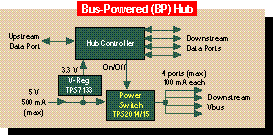
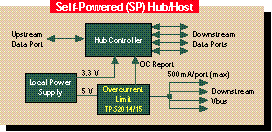
The enhancements made in the TPS2014 and TPS2015 include an undervoltage lockout (UVLO), which ensures the device will power up in the off state, and an over-current logic output, which enables the device to report faults on a power bus back to a host controller. These new features coupled with controlled switching times, which minimize the current surges during switching, makes them ideal for USB power distribution applications. The TPS2014 and TPS2015 are available in a 8-pin SOIC package. Universal Serial Bus Power Requirements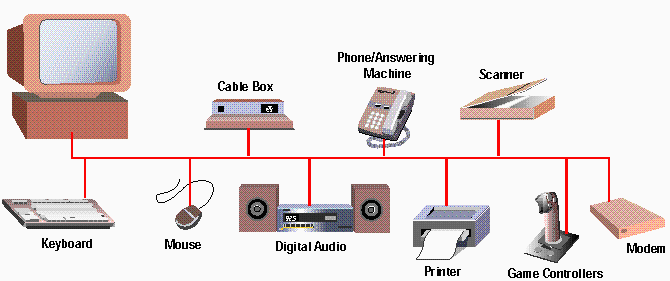 The Universal Serial Bus is a connectivity and data transmission protocol introduced to the personal computer market to improve the existing serial (RS-232) and parallel interfaces. This 12 Mb/s four wire interface features many advances over its predecessors: appliance type system, hot plug-and-play, automatic device recognition, automatic device driver unloading. USB has been conceived as a truly user friendly interface, where you would no longer have to open a PC or install device drivers when you expand your system. Not only is USB a new data transmission protocol, this interface is also designed to distribute power. The USB system is broken down into several categories for the express purpose of power management. The basic device types are: Host, Self-Power Hub, Bus-Powered Hub, High-power Bus-Powered Function, Low-power Bus-Powered Function. Every USB system will require a Host device to manage the system, and it will be able to communicate with up to 127 other devices if the system is properly configured. In order to distribute power effectively USB devices must be designed to meet all of the specifications voltage drop and droop requirements. The Host or Self-powered hub should be designed to supply no less than 4.65 V to the voltage-bus at 500 mA per port. This voltage will be fed to another downstream device across a 5m cable (max). The Bus-powered hub which is powered by the 4.65 V must deliver no less 4.40 V to a maximum of 4 downstream ports at 100 mA per port.
Vol 21 March, 1997 |
 at 5 V