



InsideShowcase (Volume 25) is available in HTML and PDF format. - 395KBVideo solutions for PC platforms Fastest low power, 10-bit, 1.25-MSPS serial ADC GPLynx simplifies 1394 implementation Single-chip, 900 MHz RF downcoverter 900-MHz RF transmit driver extends system performance 350-mW low-voltage audio amplifiers First 2-W stereo audio amplifier sytems with depop circuitry Highest-bandwidth low-voltage rail-to-rail CMOS op amp High-speed wide supply voltage op amp TCM38C17 QCombo Quad-Channel PCM Codec/Filter Combo |
TCM38C17 QCombo Quad-Channel PCM Codec/Filter ComboProduct Features
TI combos are highly integrated, single-chip PCM voiceband codecs with on-board filters. They are developed using advanced analog processes to provide a complete high-performance, low-noise solution to interface an analog voice circuit with a digital time-division-multiplexed (TDM) system. The QCombo adds multiple channel capability to TI's existing line of easy-to-use broadband connectivity solutions, helping to provide increased voice and data communications over the existing telecommunications infrastructure. The increased channel capacity will be a key factor for future voice and data transmission protocols. The QCombo consists of four pairs of transmit and receive channels. On the transmit side of each channel pair, the device converts the analog input to a coded digital signal and multiplexes it to a PCM line. On the receive side, the device separates the digital signal from the PCM line, decodes it and returns it to analog. In addition, one PCM input and one PCM output feed the digital side, and independent frame synchronization pulses provide flexibility in time slot assignment. Signal conversion is accomplished using sigma-delta (SD) conversion techniques, which provides higher signal-to-noise ratio, higher dynamic range, and reduced system cost due to a simplified anti-aliasing filter. As a result, the QCombo has industry-leading idle-channel noise for improved system performance. The QCombo is a single rail device requiring only a 5-V power supply, contributing to low power dissipation consumed per channel. The device also features a power down mode that can be configured for each channel separately. Due to its differental output, the QCombo also provides the widest voltage swing of any single rail codec, with 8 volts peak-to-peak. This output is also capable of directly driving a transformer load. Other features include auto-zero and sample-and-hold functions, an internal voltage reference, and single-ended operation. QCombo also provides pin-selectable µ-Law and A-Law companding for interoperability among industry standards for central office voiceband applications. The TCM38C17 is available in a 48-pin plastic DGG TSSOP package.
Vol 26 February, 1998 |
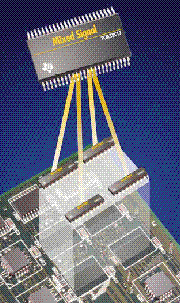 Texas Instruments has released the TCM38C17 QCombo, a quad-channel, pulse-code modulated (PCM) codec/filter combo solution for voiceband applications.

