
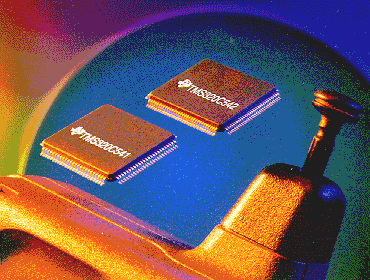
HOUSTON, TEXAS (May 15, 1995) -- Two new digital signal processors (DSPs) that lower power consumption, reduce chip count, and enable system cost savings for wireless communications applications were introduced today by Texas Instruments. The new devices combine high performance, hard-wired functionality with a specialized instruction set to effectively implement worldwide digital cellular standards, including Global System for Mobile Communications (GSM), IS-54B, IS-136, Personal Digital Cellular (PDC), and IS-95. With full-rate TI GSM software modules that run on the new DSPs, Texas Instruments is also offering a DSP solution to shorten time to market and enable efficient, cost-effective GSM applications.
The TMS320C541 and TMS320C542 are optimized for wireless communications terminals and base stations, respectively. Both DSPs provide advanced levels of performance and low power consumption. Operating at either 2.7V or 5V, the 'C54x DSPs are members of TI's Low-power Enhanced Architecture DSP (LEAD) family. The TMS320C54x DSP generation was announced last year by Texas Instruments in Japan.
With three different power down modes, these devices are well suited for wireless communications products such as digital cellular phones, personal digital assistants (PDAs), and wireless modems, all of which require power efficient components to extend battery life.
The DSPs feature 50 MIPS of processing power and have a hard-wired Viterbi accelerator that reduces Viterbi "butterfly update" down to only four instruction cycles for GSM channel decoding. The DSPs can easily implement all of the baseband digital signal processing functions in a single chip, with spare MIPS to perform other telephony tasks such as voice dialing, speaker phone and noise cancellation.
"Not only are we bringing 50 total CPU MIPS to the wireless communications system designer, but the `C54x DSPs take only an average of 12.7 MIPS to implement full-rate GSM," said Gilles Delfassy, general manager of TI's worldwide wireless communications business unit. "The remaining MIPS allow many tasks traditionally handled by ASICs or microcontrollers to be integrated onto the DSP, lowering overall system cost."
The reduction in the quantity and complexity of other system components also results in lower battery drain and reduced power consumption. "High performance and low power dissipation are both important and closely related," said Thomas Brooks, TI's marketing manager for wireless communications. "We've diminished the amount of power consumed for the functionality achieved - the number of milliwatts per function - to a point well below any competing solution."
Key 'C54x features are aimed at maximizing the DSPs' performance while enabling the low power implementation of wireless system such as voice coding and decoding. "The `C54x DSPs were designed to create a more efficient way of implementing Code Excited Linear Predictive coders (CELP) vocoders and other key digital communications functions," said Brooks. "The architecture makes it uniquely optimized for wireless communications applications-an accomplishment that clearly demonstrates TI's commitment to the wireless communications market."
To enable even higher integration and to further reduce chip count, power dissipation, and system cost, TI offers the capability to create a custom device around the `C54x DSP core. TI's customizable DSP (cDSP) technology allows the single-chip integration of the `C54x DSP core with microcontroller cores, additional memory, peripherals, and logic gates.
TI is licensing fully tested, full-rate GSM software modules that run on the `C541 and `C542 DSPs and comply with the European Telecommunications Standards Institute (ETSI) specifications. To support the fast-growing GSM market in Europe and Asia, these modules utilize the features of the optimized `C54x DSPs to shorten time to market and enable efficient, cost-effective GSM applications. GSM technology could play a role in the introduction of personal communications services (PCS) standards in North America.
TI's full-rate GSM modules perform voice coding and decoding, demodulation, encryption, channel coding and decoding, and other functions necessary for GSM systems, such as interrupt handling and control. The entire GSM code set occupies only 3,170 words of RAM and 11,496 words of ROM and requires an average of only 12.7 MIPS.
"These software modules are another example of TI's commitment to providing system-level solutions," said Delfassy. "Today's chip vendor cannot just supply DSPs, but instead must look at the big picture, from complementary ICs, to tools, to software and provide DSP solutions."
The `C541, with 28K words of ROM and 5K words of RAM on-chip, is optimized for wireless terminals. The `C542, optimized for wireless base stations, includes a host port interface and a buffered serial port and features 2K words of ROM and 10K words of RAM. Both parts are available directly from Texas Instruments only for high volume wireless communications applications.
The `C541 is available today from Texas Instruments at a 250,000-piece price of $23 each. The device is housed in a 100-pin thin-quad flat pack (TQFP) package.
The `C542 is now sampling and is scheduled to be available in production quantities during the fourth quarter of 1995 at a 250,000-piece price of $26 each. The device is packaged in a 128-pin TQFP. The `C54x devices are not available through distribution.
# # #
Reader Inquiry: 1-800-477-8924, ext. 5300
Profile number: SPR139