


|
PCI1131 Fact Sheet
Reader Inquiry:
|
Industry's First Next-Generation PCI Bus-to-CardBus™ Controller is PC 97 Ready
Because TI's new PCI1131 controller meets the Microsoft® PC 97 design guidelines for PC Card™ and CardBus controllers in next generation PCs, OEMs can be confident that the PCI bus-to-CardBus interface will function efficiently with the Microsoft Windows® operating system and Windows-based application programs. The PCI1131 follows the PCI1130, the industry's first CardBus controller introduced over one year ago. Since its introduction, the PCI1130 has become by market share the de facto standard for the industry. The PCI1131 supports two 32-bit CardBus credit-card-size add-in modules that give the PC access to peripheral devices, such as modems, video programming, external video monitors and local area networks. The device will also support 16-bit PCMCIA (Personal Computer Memory Card International Association) or PC Card add-in modules. "Because of our leadership in the CardBus market, we were able to quickly bring to market a PC 97-ready CardBus controller for PCI bus systems," said Ed Agis, TI's strategic marketing manager for PCI bus products. "Having a controller that conforms to the Microsoft PC 97 guidelines will help notebook and desktop PC OEMs bring their new systems to market faster because it simplifies the task of interfacing hardware and software to the operating environment. And at 45 megabytes per second (MB/s), the performance of this controller will allow end users to run applications that are input/output(I/O) intensive much more efficiently." The 45 MB/s speed of TI's PCI1131 controller is required to handle several I/O-intensive applications simultaneously. For example, should the user of a notebook computer want to take part in a video teleconference, the PCI1131 has enough I/O band width for the notebook to be connected to a high-speed network like Ethernet 100BaseT for receiving the teleconferencing signals and a CardBus video card connected to an external, big-screen, high-resolution TV monitor for displaying the teleconference's video signals. In contrast, the limited PCI bus-to-CardBus bandwidth of competitive controllers would be devoted entirely to one high-speed video connection, eliminating the possibility of the system supporting a second CardBus or PC Card add-in module.
The PCI1131 has also been optimized for low power consumption
to extend the battery life of notebook PCs and other portable
systems. The PCI1131 consumes just half the power of TI's previous
generation PCI-to-CardBus controller. In addition, the PCI1131
automatically reduces its power consumption when the add-in I/O
modules are not in use and when one or two 16-bit PC Cards are
inserted in the system rather than 32-bit CardBus modules. Video Options
Because the PCI1131 supports two video options, PC system designers
can use this device in a range of platforms, beginning with entry-level
systems and including more expensive multimedia platforms. For
example, lower-cost notebook PCs can use a "Zoom Video"
add-in module and the PCI1131 will route video signals directly
to the PC's graphics controller. Higher-end multimedia platforms
will require high-speed, high-resolution video. In this case,
the PCI1131 can handle video signals from a 32-bit CardBus video
capture card and route them over the PCI bus to the system's graphics
controller. This latter method will produce a full-screen video
display of higher-resolution than is possible with Zoom Video.
Mixed Voltages
The PCI1131's compatibility with a mixed 3- or 5-volt power environment
makes it easier for developers to design it into PCs. In addition,
this capability offers extra flexibility to end users by allowing
the system to accept virtually any add-in card. The PCI1131 will
work with either a 3- or 5-volt PCI bus and either 3- or 5-volt
add-in cards. Users can mix and match PC Card or CardBus cards
of either voltage in the same system. Another benefit to the
end user is the device's hot insertion capability, which allows
add-in cards to be inserted or removed without powering down the
system. An easy migration path is provided to the PCI1131 from
TI's previous generation controllers. All devices in TI's family
of CardBus controllers are packaged in 208-pin Thin Quad Flat
Pack (TQFP) carriers and they are all pin-for-pin compatible with
each other. Pricing and AvailabilityThe PCI1131 is available now from TI and its authorized distributors. The suggested resale pricing in quantities of 150,000 is $14.60.
Trademarks:
Microsoft and Windows are registered trademarks of Microsoft Corporation. |
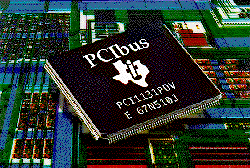 DALLAS (Oct. 28, 1996) -- The industry's first next-generation
CardBus controller, Texas Instruments (TI) PCI1131, simplifies
hardware and software development efforts for designers of PCI
bus-based notebook and desktop PCs by being PC 97 ready and offers
throughput bandwidth significantly greater than that of other
CardBus controllers on the market today.
DALLAS (Oct. 28, 1996) -- The industry's first next-generation
CardBus controller, Texas Instruments (TI) PCI1131, simplifies
hardware and software development efforts for designers of PCI
bus-based notebook and desktop PCs by being PC 97 ready and offers
throughput bandwidth significantly greater than that of other
CardBus controllers on the market today.