


|
Related Documentation: Technical Fact Sheet
|
New 3D Graphics Processor Brings Compelling High-End Realism to Consumer Applications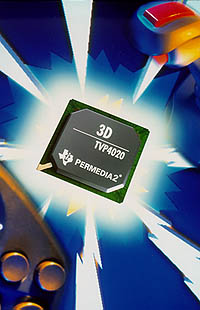 DALLAS (May 26, 1997) -- A new addition to Texas Instruments (TI) family
of 3D graphics processors will bring the type of visual realism previously found only in high-end
workstations to a variety of consumer applications, including Personal Computer (PC) gaming, virtual
reality and virtual world wide web (WWW) browsing. The device integrates the three
most important graphics functions required by the demanding consumer segment: high-performance 3D,
leading 2D graphics acceleration and advanced video processing. The device's features include a
geometry set-up engine for accelerated 3D triangle processing and an award-winning 230 MHz random
access memory digital-to-analog video converter (RAMDAC).
DALLAS (May 26, 1997) -- A new addition to Texas Instruments (TI) family
of 3D graphics processors will bring the type of visual realism previously found only in high-end
workstations to a variety of consumer applications, including Personal Computer (PC) gaming, virtual
reality and virtual world wide web (WWW) browsing. The device integrates the three
most important graphics functions required by the demanding consumer segment: high-performance 3D,
leading 2D graphics acceleration and advanced video processing. The device's features include a
geometry set-up engine for accelerated 3D triangle processing and an award-winning 230 MHz random
access memory digital-to-analog video converter (RAMDAC).
Additionally, the device supports both the PCI (Peripheral Component Interconnect) and AGP (Advanced Graphics Port) buses, as well as all leading 3D graphics application programming interfaces (APIs), including the Microsoft® Direct3D™ and Silicon Graphics OpenGL® APIs.
"Long before the word multimedia was coined, TI demonstrated its expertise in many of the key competencies
that make up a multimedia experience, such as digital image processors and mixed-signal RAMDACs," said Steve
Nelson, TI's 3D graphics marketing manager. "This addition to our growing family of graphics processors
shows how we can not only bring together advanced technologies involving video and graphics processing,
but also do so in a cost-effective manner for add-in board manufacturers and PC OEMs. The multimedia
capabilities of this chip can bring to consumer PCs the level of visual realism that was previously
unaffordable." TI/3DLABS AllianceThe TVP4020 is TI's second generation graphics controller to incorporate PERMEDIA™ 3D graphics technology from 3Dlabs®. Last year, TI and 3Dlabs signed a cross-licensing agreement giving TI access to 3Dlabs' advanced graphics processing technology and 3Dlabs access to TI's industry-leading RAMDAC technology. The agreement also assured fabrication capacity at TI's world-class manufacturing facilities. Additionally, TI plans to use its considerable expertise in digital signal processing (DSP) solutions and mixed-signal processing in the development of future graphics processors with 3Dlabs.
"TI has long been known for the quality of its semiconductor manufacturing processes, and it is a
tremendous benefit for 3Dlabs and PERMEDIA customers to know that they can rely on TI's manufacturing
prowess," said Neil Trevett, vice president of marketing at 3Dlabs. "The combination of 3Dlabs and TI's
design skills and TI's manufacturing capability makes this relationship a potent force in the graphics
chip industry." High Performance 3D EngineThe new device, which is designated the TVP4020, can process one million polygons/second and render 80 million pixels/second. Its performance surpasses the needs of the most demanding PC gaming applications. The TVP4020 also includes a single-pixel divide function for faster perspective correction and an eight-bit color texture palette that reduces memory requirements by texture compression. Faster Z-buffered modes also improve overall 3D acceleration performance. The TVP4020's interface to Intel's AGP bus supports the latest emerging standard in PC graphics architectures.Leading 2D Graphics AccelerationThe TVP4020 will operate as a Windows™ accelerator and includes fast SVGA (Super Video Graphics Array) capabilities on-chip. Further, the TVP4020's sophisticated 3D execution pipeline can process special 2D features such as texture units used for tiled blits, chroma key test used for transparent blits and bilinear filter used for stretch blits for even faster 2D performance. The device supports all popular screen resolutions and refresh rates up to 1600 x 1200 pixels at 83 Hz.Advanced Video ProcessingThe TVP4020 is capable of full-screen (1024 x 768 pixels), high-resolution MPEG 1 and 2 playback at 30 frames per second (FPS) using 24-bit color. The device supports simultaneous live TV video input and output channels for applications such as video conferencing, virtual reality and video editing. The TVP4020 includes video features, such as XY scaling and filtering, for manipulating and displaying live video on either a full screen or inside a window on the screen. The device includes a color space converter, which reduces CPU and bus loading, thereby freeing resources for other tasks.Optimized Software DriversThe TVP4020 is supported by a comprehensive set of software drivers that conform to the most popular APIs in the industry. This assures the device can be used in a broad range of applications from immersive gaming to commercial environments. APIs supported include Microsoft's Direct3D, Silicon Graphics OpenGL and Autodesk's Heidi™. The TVP4020 provides true hardware acceleration of applications written for Microsoft's Direct 3D API.Pricing And AvailabilityThe TVP4020 is offered in a 272-pin PBGA (plastic ball grid array) package. Samples of the TVP4020 are expected to be available from TI and its authorized distributors later in the second quarter of 1997. Production quantities of the TVP4020 are anticipated to be available in the third quarter of 1997. Suggested resale pricing of the TVP4020 in quantities of 50,000 is anticipated to be $35 per unit.# # # Trademarks: |