New TI RF Device Minimizes Power Requirements and Costs in Mobile Phones with North American Footprint
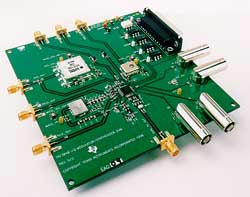
DALLAS (June 8, 1998) -- A highly integrated RF component targeting dual-band, dual-mode applications that will enable wireless original equipment manufacturers (OEMs) to create more affordable, longer-operating mobile phones able to function seamlessly throughout North America was announced today by Texas Instruments. The enhanced operational characteristics of the RF modulator/synthesizer provides OEMs with the design flexibility they need to increase system power efficiency for longer talk and standby times, as well as keeping overall system space, weight and cost to a minimum.
"The TRF3040 Modulator/Synthesizer is an important milestone in our roadmap to build a leadership RF portfolio. Along with our power management and analog baseband offerings, this RF device demonstrates TI's capability to leverage its leadership in analog and mixed-signal technologies for the wireless communications market," said Gilles Delfassy, director of the worldwide TI Wireless Communications Business Unit and Texas Instruments Vice President.
Greater Flexibility
The highly integrated TRF3040 allows OEMs to develop products that operate in both the 900-megaHertz (MHz) cellular and 1.9-gigaHertz (GHz) Personal Communications Systems (PCS) frequency bands used in North America. Specifically, the device supports the traditional analog AMPS transmission standard used at 900 MHz, plus the IS-136 digital standard used at both 900 MHz and 1.9 GHz. The dual-band, dual mode features of the '3040 give OEMs greater flexibility to create handsets that can operate as needed in different regions of the U.S. and Canada.
"The '3040 helps simplify design and reduce costs for wireless OEMs, allowing them to provide faster delivery of affordable, differentiated products tailored to the markets they need to address," continued Delfassy. "To this end, this modulator/synthesizer also complements the flexibility, scalability and programmability of our other wireless baseband products."
Improvement of Internal System Performance
The '3040 characteristics are designed to help improve internal system performance, giving OEMs the means to minimize costs and take advantage of lower power consumption in their designs. First, the device features a high degree of variable gain amplifier (VGA) linearity, which serves to minimize spectral regrowth, the noise that spreads from a signal's carrier frequency into nearby frequencies. The '3040's high VGA linearity allows OEMs to use transmit power amplifiers with less performance (e.g., linearity) margin, and are thus less costly, yet still meet the applicable standard's requirements for spectral purity. In many cases, these power amplifiers can operate on less power -- an important plus since the power amplifier is the single greatest consumer of power, and thus battery life, in the system.
Second, the '3040 features a low spurious content -- the unwanted signal noise that is the byproduct of mixing frequencies, an operation that RF systems must perform to translate baseband encoded voice and data to RF carrier frequencies compatible with today's cellular and PCS wireless systems. Low spurious content allows OEMs to meet the standard's requirements through the use of less expensive filter components and power amplifiers in the system. Low phase noise also serves to simplify design and reduce cost. All of these features help minimize system power requirements, in the end resulting in designs that permit longer talk and standby times for users.
Ease of Design
The '3040 helps simplify design and reduce space and weight through a high level of integration. TI's advanced RF BiCMOS (Linear) process allows the unusual combination of a 900-megaHertz (MHz) transmit modulator and 2.2-gigaHertz (GHz) synthesizer functions in a single chip. In addition to reducing component counts by integrating these functions, the device also eliminates the need for a separate 900-MHz up-converter. The on-chip fractional-N synthesizer allows faster lock-in time with shifting frequencies for better performance during handoffs.
Typical operation at 3.75 volts and 150 milliamps (mA) keep '3040 power requirements low, and a sleep mode brings power-down current to less than 2 mA. The device's three-wire serial interface allows for ease of programming. "These specifications are another demonstration that TI has built the right RF core competencies to drive additional functional integration and to support even more transmission standards in future RF products," concluded Delfassy.
Availability, Packaging, Pricing
TI is now sampling the TRF3040 Modulator/Synthesizer. Evaluation modules are scheduled for August, and volume production is scheduled for late third quarter of 1998. The device is delivered in a 48-pin thin quad flatpack (TQFP) package. Planned pricing is $6.07 each in quantities of 10,000.
More information regarding TI's Wireless Communications Business Unit and its products is available on the World Wide Web at  http://www.ti.com/sc/docs/wireless/home.htm



 Related Documentation: