


|
Wireless Terms
Introduction
|
System IssuesFigure 1 shows a high-level generic block diagram of a cellular handset, along with a typical functional and cost breakout for each of the four major subassemblies in the telephone: the package, baseband electronics, radio frequency (RF) electronics, and the battery and associated power supply electronics. The design choices behind the construction of this type of system are driven by three major criteria: cost, power and weight, and system performance.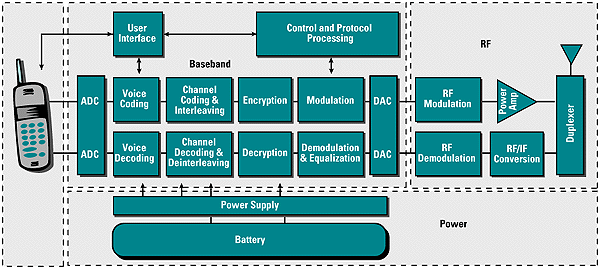
CostWith new PCS licenses opening up, service providers may not be able to maintain the premium on air time they have had.Different market segments in the wireless industry tend to approach the cost equation differently. Cordless systems, for example, have generally been quite affordable for the average consumer, who purchases both a handset and base station. Since users of most cordless systems are not charged for their air time, this makes sense, although it is likely that future cordless applications will incur air time charges when the phone is used outside of the home area. The cellular industry has an entirely different approach. Service providers expect to make money on air time charges in order to recoup the cost of the handset, which is widely subsidized by the carrier. Subsidies vary depending on location, but amounts up to $300 are common. With new PCS licenses opening up, service providers may not be able to maintain the premium on air time they have had. They will be forced to compete by lowering air time charges and weaning the public from expensive subsidies for handsets. Whatever happens, cost pressure on component and sub-system vendors will be sure to rise dramatically. Currently, the rate of cost erosion in this industry is about 20 percent per year. Power and weightSince the weight of a wireless handset is dominated by the battery, these two factors reduce to one: power. Today, the bulk of the power consumption in a cellular terminal is in the power amplifier in the radio. However, as we move toward an era of micro and pico cells, transmit power will drop dramatically from the current 1-watt area to perhaps a few tens of milliwatts. When that happens, the major power driver will become the DSP.One of the most straightforward techniques for reducing power is to lower the voltage. Older phones generally operate at 5 volts. New phones typically use 3 volts, with sub-2-volt systems on the horizon. Since power varies as the square of voltage, this represents a dramatic reduction in power consumption. This trend results in two issues for component vendors:
Today, digital and analog IC technology is rapidly lowering operating voltages -- a trend that will continue in the years ahead. The figure below shows how changes in process technologies will continue to lower operating voltages and power consumption. RF IC Process Roadmap Figure 2. Smaller transistor geometries in digital and analog ICs mean lower power consumption, which in turn allows designers to build smaller, lighter-weight systems with longer talk and stand-by times. There are other techniques for reducing power consumption as well. Systems can be partitioned for better power management by allowing circuitry to be turned off when it is not needed. In addition, functions can be allocated so that they can be executed with minimum power. For example, tradeoffs can be made between functions executed by the MCU or the DSP, or between the DSP and hardware data paths. Clock rates and even the design of software can affect power consumption. Finally, at the component level, processor architectures, transistor designs and semiconductor processes all play into the power equation. System PerformanceNew features for product differentiation require increased performance, functionality and versatility.A handset must at least meet the standard for which it was designed and interoperate with a variety of wireless infrastructures from different manufacturers. Product differentiation comes from introducing new features that exceed the standard in areas which matter to the consumer. New features, however, will require increased performance, functionality and versatility.
|
