


|
Wireless Terms
Introduction
|
Wireless Telephone RequirementsDigital technologies are extending cordless communications to cover low-mobility, pedestrian application in environments such as office buildings, shopping malls and airports.The user requirements that drive design tradeoffs and technology choices for local-area cordless telephones and wide-area cellular telephones can be diametrically opposed. Cordless systems were invented to satisfy a need for tetherless communications in the home. These systems tend to be larger and bulkier than their more complex cellular cousins, since users do not normally carry their handsets except during calls. Until recently, analog systems with proprietary transmission standards dominated the market. Now, however, especially in Europe and Japan, digital technologies are extending cordless communications to cover low-mobility, pedestrian application in environments such as office buildings, shopping malls and airports. These cordless applications require non-proprietary standards, since the infrastructure vendor may no longer have a monopoly on subscriber instruments. While cordless phone designers have not been motivated to push the size/weight envelope for home-based systems, they will be for future low-mobility PCS systems. Since cell sizes in these applications are small, high cell capacities and high transmit powers are not a requirement. In fact, low transmission powers are an advantage, since they allow reuse of a frequency channel a short distance away. Cordless systems are used in locations where there is generally a wireline alternative; consequently, they must compete directly in terms of service quality and convenience. Standby and talk times must be measured in weeks and days -- rather than hours and minutes. Voice quality must be comparable to what is easily obtainable in the instrument on the desk or the pay phone on the wall. Cellular systems are very different. A key requirement is high mobility and the capability to hand off from one cell to the next while traveling in a high-speed vehicle. Coverage, spectral efficiency and system user capacity are additional requirements driving cellular systems to use complex modulation techniques for more efficient use of the available spectrum. Voice coding and complex error correction techniques reduce the number of bits required to reliably represent and transmit voice. Because of the large cell areas, transmitter powers are measured in hundreds of milliwatts and even watts. Table 2 compares the key requirements driving cellular and cordless telephone designs. 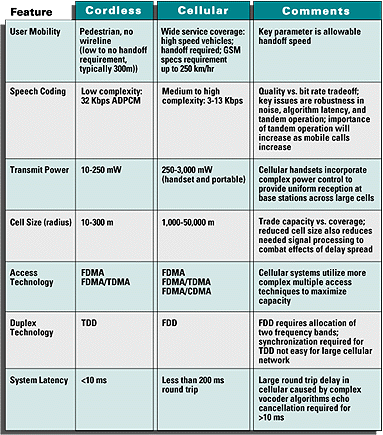 Table 2. Different user requirements for digital cordless and cellular telephones demand different technology choices. Transmission standards are an even more significant issue with cellular and wide-area PCS phones than they are with cordless phones. Although older analog standards have supported the cellular industry successfully in the past, only digital transmissions will handle the increase in capacity required in future. Depending on the standard, digital transmission offers from twice to ten times the call capacity of analog. Table 3 lists the major digital transmission standards for wireless telephones. 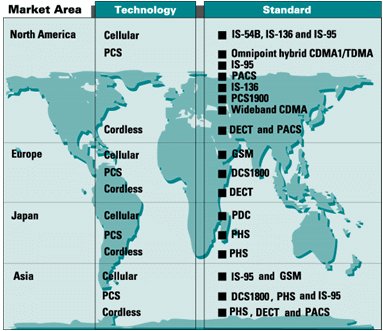 Table 3. Although digital transmission standards are varied, they have one big advantage -- bandwidth. Digital standards support up to 10 times the channel capacity of analog standards. Service providers are highly motivated to shift to digital transmission because the cost of supporting a digital user is a small fraction of the cost of supporting the same user on an analog system. (For IS-54B/136 that fraction is roughly 1/3.) However, unless the carrier passes on those cost savings, the end user is not so motivated. Moreover, early systems have not lived up to user expectations of higher quality. The enticement for users to switch to digital may have to come through enhanced security (through the use of digital data encryption) and a wider range of services (such as short message services, which will effectively provide embedded alphanumeric paging capabilities). |
