|
Texas Instruments Wireless Symposium & Exhibition Keynote Address Making Wireless Work In The New Century
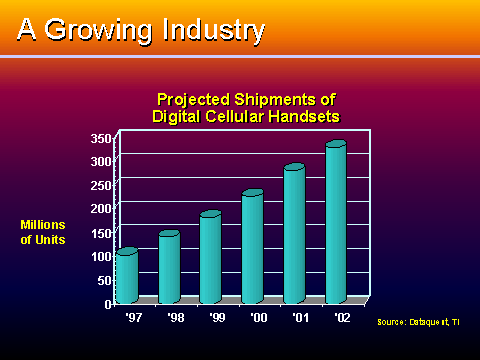
Christian Dupont, Director of the Americas, WCBU Bon jour, mesdames et messieurs, vous n’avez pas de probleme avec le Francais bien sur? OK as everybody speaks French here I will do it in English !! Good morning, I appreciate the opportunity to lead-off the 1998 Wireless Symposium. It is an honor and a privilege to be invited to this event...and to share this week’s stage with some of our industry’s best thinkers. It is also somewhat humbling, given the topic I have been asked to address — our vision for the future of wireless. After all, my company — Texas Instruments — is only a supplier to this industry. As such, our role is perhaps more to enable the future...than it is to shape it, or set a strategic direction for it. But having said that, let me also say this: We expect our technology to contribute to a strong future for wireless. And we think it is essential that every player...at every position in the value chain...take a strategic approach to this business. We must all share a vision for the future of wireless. Otherwise, we will surely impede the growth of one of the most dynamic industries in history. In my time this morning, I will explain how we, in TI, are working to help our customers meet new demands on the end-equipment side of the business. But before we talk about future directions of semiconductor technology, let us set the stage by taking a closer look at the dynamics of this remarkable business. I am sure you have realized it, but ‘97 was a booming year for the global wireless industry. A basic comparison, for the first time ever the shipments of digital cellular phones surpassed those of personal computers. By year’s end, the total number of digital cellular phones built reached some 86 million units worldwide...and by the way, about 50 million of those phones contained TI's DSPs. I think we can say, TI has a strong presence in a strong market...and that gives us a good reason to pay serious attention to the future of wireless.
One thing we find especially appealing about this market is that there is no slow-down in sight: Industry forecasts project that digital cell phone shipments will grow another 45 percent — to 125 million phones — in ‘98. Here is another way to measure the enormous opportunity in wireless: If you look back over this century, you will find that it took about 77 years for the traditional wireline telephone industry to reach 50 million U.S. subscribers. 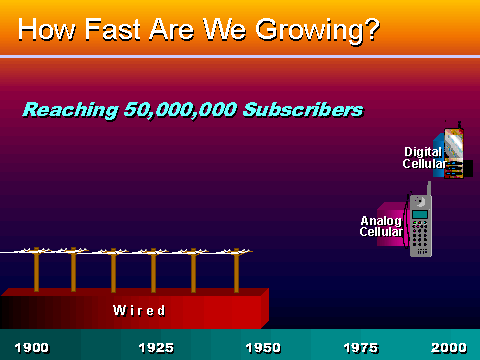
As you might expect, the wireless business has grown at a much faster rate. In fact, it took just 14 years for analog cellular technology to go from zero to 50 million subscribers. That is over five times faster. Meanwhile, digital wireless technology has been having an even more impressive track record. GSM, the first all-digital wireless technology, recorded its 50 millionth subscriber in ‘97 — just five years after the first GSM systems were launched in Europe. What do these numbers tell us? To me, they say that we clearly picked the right market! And I believe that the wireless industry, has an extremely bright future. And it is because we are selling a product with an almost universal appeal. Think about it: There are not many human needs which are more fundamental than the need to communicate. We all need to eat, of course. That is probably number one. Next, most people think it is important to have lets say "a good relationship with another person". But the need to communicate would not be far behind on our list of priorities. It is an integral part of who we are. I would argue that wireless technology is popular, precisely because it helps us address that basic human need. It helps us keep in touch — with whomever we choose...and wherever we happen to be. In that respect, wireless is different than many electronic technologies. We have all seen the classic trends take shape in the consumer markets, whether it is calculators...TVs...or VCRs. A new device is invented...a critical mass develops...sales ramp up...and then, the market saturates. Growth rates level off. Before long, the business is not nearly as attractive as it once was. It becomes a price play...and competitors struggle to keep their products from becoming commodities. I believe we have the opportunity to pursue a much more attractive curve in the wireless business. The dynamics of this industry can be different. The growth curve can continue along a much more robust path — especially if we take a strategic approach to developing our next-generation systems. Another reason for this is the very nature of communications to feed on itself...to create new opportunities for keeping in touch. A new technology does not wipe out the old. Wireless phones do not make wireline phones obsolete. If anything, wireless technology creates more demand...and more types of demand...for service providers. I already mentioned that digital cellular systems claim more than 50 million subscribers. But here is what makes that number intriguing: The fact that the vast majority of those digital cell phone users also have wireline phones. In Europe...in the U.S...in Japan...most people already have a way to stay in touch. But that does not keep them from going wireless. Just the opposite is true: The world’s most well-connected countries have become the early adopters of wireless technology. We and our neighbors understand just how much communications technology can enrich our lives — so we are always looking for more, and better, ways to communicate. Now, what happens when you add in the fact that fully 80 percent of the world’s population do not own a phone today? Or that half of them have never used a phone? It seems pretty clear that we are a long way from saturating the market for wireless communications. As fast as we have grown over the past decade, our boom times probably still lie ahead. That is both an exciting prospect...and an enormous challenge. To understand why, you need only to consider the direction we are heading as an industry. Today’s state-of-the-art wireless service is still a relatively simple proposition. For the most part, you are talking about voice-only transmissions. Some wireless users demand data transmission...but not many. 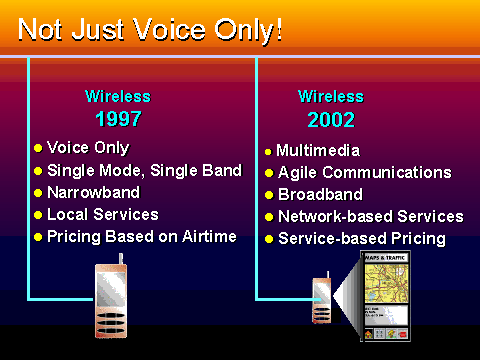
Today’s wireless phones and systems are generally single-mode, as well as single-band technology. They provide relatively limited bandwidth. And they are used mostly for local services...with pricing based on the airtime. Five years from now, that profile of wireless communications is likely to change — and change dramatically. As I said, new technologies do not wipe out the old: They tend to build on each other, and reinforce each other. And so, in the coming years, we can expect that wireless users will be putting many new demands on their service providers. They are going to want the same level of connectivity, no matter where they happen to be, or what network they happen to be using. And that expectation will put drastic new requirements on all of us...to enhance the technology we offer. What will the future look like in wireless? I do not have a good crystal ball, but we can assume it will be different. In 2002, wireless users will not be satisfied with voice-only service. They will demand multimedia capability from their personal communications devices. Nor will they settle for single-mode functionality. People will not want a phone that only works in some coverage areas. They will expect to be able to stay in touch, no matter where they are. 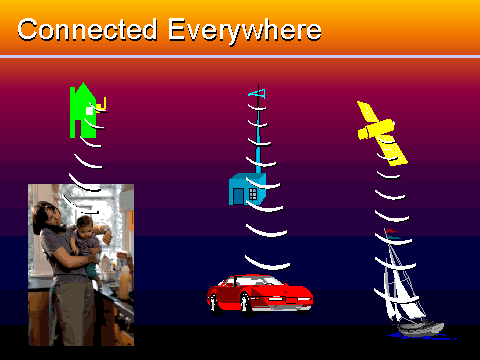
When they are at the office, the phone might connect through a local network. When they are at home, the same phone might be linked to a small home base station. When they are on the road, it will connect through a cellular tower. And when they are on a fishing trip, deep in the woods of Canada, the phone will have to be capable of connecting, via satellite, to any other phone in the world. That kind of agility will not come easily. And that is just the start. Why? Because tomorrow’s customers are also likely to demand many more applications, and much more sophisticated applications, than they do today. They will want to transmit images and files. They will want to program "web-bots" from their handsets, to retrieve information from the Internet. Perhaps they will even want to download new functions, or share data across networks, on demand. 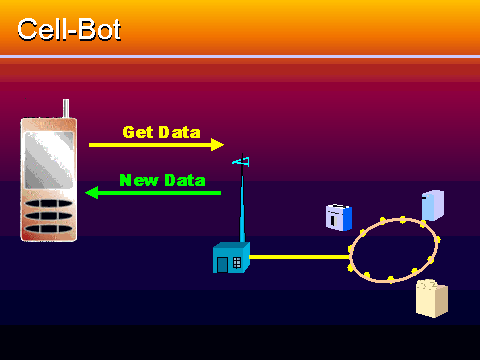
Most of these applications will require a lot of data movement...and therefore, future systems will have to be capable of providing much greater bandwidth than today’s wireless networks. And tomorrow’s phones will have to be capable of supporting these advanced features and applications In short, tomorrow’s wireless systems and equipment will seem less like discrete islands of technology...and more like integrated tools...for doing all the different types of communication people need to do every day. That is what I mean when I say that the coming years will present both an exciting opportunity...and an enormous challenge for the wireless industry. In order to capture all the growth we have available to us...in order to stay relevant in a rapidly changing marketplace...we will have to reinvent the way we do business. And we will have to do it, while continuing to run an industry that is growing at the torrid pace of 45 percent per year. It is a large task, no question about it. Fortunately, we believe we have a model for getting the job done on the end-equipment side of the business. It is a model based on the flexible combination of hardware and software platforms. It is a model which has grown from the productive partnership between leading digital cell phone manufacturers...and semiconductor makers like Texas Instruments...over the past several years. Before I talk about this next-generation model in detail, let me set the stage by providing some background about our experience as a supplier to the wireless end-equipment industry. We first teamed up with phone makers like Ericsson and Nokia in the early 90s — providing DSP’s, to handle the heavy-duty throughput requirements of real-time digital communications. Very quickly, it became clear to us that semiconductor technology in general, and DSP technology in particular, had a lot to offer the wireless industry. This is why TI technology strengths are aligned with the industry’s care-abouts — whether you are talking about processing speed...power consumption...or overall system cost. What was true then is even more true today. When you look at the environmental drivers in the industry, it is obvious that leading-edge semiconductor technology...and the needs of the wireless industry...are a match made in heaven. One key trend in semiconductors, for example, is continued improvement in submicron processes — from 0.35 micron technology a few years ago, to 0.18 today. This new technology makes it possible to deliver enormous improvements in terms of semiconductor performance: Today’s chips use far less power and perform far more complicated tasks...than those of only 8 years ago. And you can see the impact of those improvements in the size, functionality and battery life of today’s digital wireless phones. At TI, we measure the improvements against a number of key benchmarks...
It is important to note that wireless applications are not an afterthought when it comes to driving these improvements in semiconductor technology. Chipmakers like TI are pouring enormous R&D resources into wireless product lines. In fact, wireless applications were the primary driver when we defined our new 0.18 micron process...when we recently demonstrated the first 1-volt DSP and it is even more the case today when we define the semiconductor technology for 2000. That was not always the case. It used to be that other end-equipment markets set the parameters for our R&D activities. Markets such as the memory business and the computer processing business were the driving force that pushed us to build what I call: the "Super-Go-Fast technology" which was the one we used to develop. But today, much of TI technology improvement efforts are being driven by the needs of our wireless phone makers. Processing speed is of course important to these customers, but it’s not enough. They are also very much interested in reducing power consumption...and in controlling total system costs. When we first entered this business, we sold our customers general-purpose DSPs. Today, we offer products that have been defined and optimized for digital cell phone applications. That means we start from algorithms to be implemented...we then identify the most important instructions to do this implementation...and finally, we define the optimum DSP architecture to run those instructions. The work we have done to understand the wireless end-equipment market... and to better serve its needs...has certainly paid off for us. In just five years’ time, we have built our wireless semiconductor products into a business that is rapidly approaching a billion dollars in annual sales worldwide. But it is not just TI — and the semiconductor industry — who have benefited from the approach. I think it is safe to say the wireless industry has benefited, too. After all, it is largely because of optimized semiconductor solutions that phone makers have been able to improve the functionality of their phones, reduce their size to 130 cc and weight to 130 gr, and extend battery life to a couple of weeks as the newly introduced Nokia 6100. Would the industry have grown as far...and as fast...if end-equipment had not evolved as quickly as it has? Probably not. In a very real sense, the opportunity to create today’s extraordinarily vigorous wireless marketplace...grew out of the industry’s ability to pursue a shared vision and strategic direction.
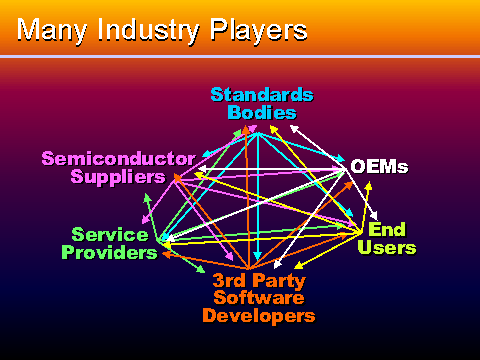
Equipment makers...semiconductor suppliers...have all been working toward the same goal of making voice communications more portable, more affordable and more widely available. And the results of the past five years speak for themselves. As we look ahead, it seems clear that the same type of vision is necessary to help the industry address its emerging challenges. We can be sure that significant changes are on the way...changes that will require an even stronger alignment among all the players in the industry — the system operators, the phone makers, the semiconductor suppliers, and every other company involved in wireless communications. We will need greater alignment across the board, because we know that end-users will be demanding a wide range of sophisticated features. This development of the wireless market will attract more and more wireless service providers. We can imagine that in the U.S., and other major markets, there will be a minimum of five carriers per region. That means the pressure will be on each carrier to differentiate its services. It will also increase the need to support roaming footprints...and increase the complexity of providing that support...within each market. Service providers are not the only ones who will face challenges, of course. Systems engineers and equipment manufacturers will also be called upon to increase the agility of their systems. We will have to start thinking about building systems and end-equipment that are capable of handling a range of personal communications tasks. One approach for doing that is to rely on software solutions. More and more, I think we are likely to find that advanced functionality will not be built into every phone. Instead, it will come via software, downloaded from the network. Tomorrow’s users will want to be able to configure...and reconfigure...their end-equipment in an endless variety of ways. And we will need to provide the systems which are capable of making that happen. Continue... |