


 In this Issue New 32-bit ARM-based microcontroller 'C240 DSP lets designers eliminate hydraulics PowerFLEX packaging designed for auto needs Automotive Solutions from Texas Instruments Value engineering in today's cars Silicon integration: panacea or problem? |
Silicon integration: panacea or problem?By Eugene R. McFarland, vice president worldwide automotive segment for TI's Semiconductor Group, and James D. Richardson, principal and technical fellow of Delco ElectronicsIn a paper written for Convergence, Eugene R. McFarland, vice president worldwide automotive segment for TI's Semiconductor Group, and James D. Richardson of Delco Electronics, explore the potential advantages and potential problems of creating single-chip silicon solutions for automotive applications.
Intuitively, a single-chip silicon solution integrating digital, linear, memory and power functions appeals to the system design engineer because of potential size reduction, fewer connections for increased reliability, simplicity and reduced cost. Previously, device prices, availability, time-to-market, software, risk and other considerations favored the more traditional multi-IC approach to system design. PRISM, a product-based design methodology, was created by Texas Instruments and Delco to quickly and cost-effectively integrate the necessary technology to produce a very competitive single-chip silicon solution for many current automotive applications. Development time: one of the major constraints to a single-chip dedicated solution -- has been reduced to several months rather than years using a reusable design methodology. Two applications: a GM body computer and a PC board in a GM cluster -- compare the results using single-chip systems ICs and more traditional multi-chip implementation. The authors, Eugene R. McFarland, vice president worldwide automotive segment for TI's Semiconductor Group, and James D. Richardson of Delco Electronics, will serve on the Convergence Enablers and Inhibitors panel at 10 a.m. Oct. 22 at Convergence. |
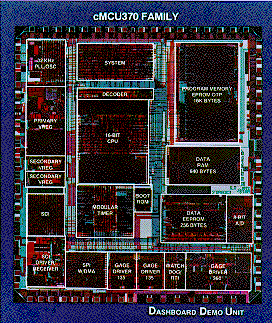 PRISM technology has enabled this instrument cluster design to be reduced to a single cost-effective chip solution.