



In this Issue
DSP Solutions:
Other Stories:
Product Update |
PerformanceThe TMS320C6x pushes the envelope with 10 times the MIPS performance of other DSPs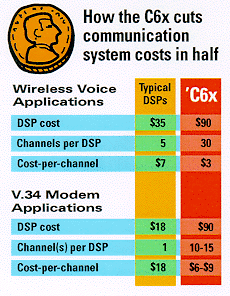
1600 MIPS power of the TMS320C6x enables never before imagined applications and makes existing ones better and more powerful at a lower cost. The performance meets user demand for more personalization, connectivity and portability in their products. 'C6x power speeds Internet downloads by up to 120 times. This opens a new spectrum of application potential, including higher density pooled modems, wireless base stations and multi-channel voice processing systems. With its software-focused design, the 'C6x enables programmable modems that can be easily adapted as standards change and communication techniques improve. Applications well-suited to take advantage of this performance include universal wireless communications, data communications to open up Internet bottlenecks, new telephone features, intelligent cruise control and personalized home security and home management systems. "The revolutionary architecture of the 'C6x provides unprecedented DSP performance at a competitive price point and with a small footprint," said John Landau, vice president strategic marketing and general manager, Dialogic Architecture Labs. "This, combined with the tools supplied by Texas Instruments and its third parties, makes the 'C6x a powerful choice for many of today's most demanding computer telephony applications. Such applications characteristically require more than one instance of multiple algorithms to serve multiple users. These applications are, therefore, computationally intensive and demand the level of performance that the 'C6x is able to deliver." The TMS320C6201 -- the first device in the family -- provides new levels of performance and cost savings for communications applications. 'C6x generation DSPs can increase the number of communication channels implemented on one DSP or raise the throughput capacity of a single channel. 'C6x generation DSPs are the first with the power to implement real-time digital subscriber line (xDSL) communications on a single programmable processor. At 6 million bits-per-second, 'C6x-based xDSL systems improve Internet download speeds by up to 120 times. xDSL shares the same phone line with the telephone service, but because it uses a different part of the phone line's bandwidth, it does not interfere with normal phone service. This is possible because there is a significant amount of unused capacity in current phone wires. Thus, a caller will be able to hook up xDSL modems to a local Internet Service Provider (ISP) and still talk on the phone -- all using the same phone line. In addition, a file that takes 10 minutes to download with the fastest current modem will now take less than five seconds using a 'C6x-based xDSL system. 'C6x generation DSPs allow remote access server (RAS) designers to provide more modems in less space. A single 'C6201 can implement 10 to 15 V.34 modems at about $6-$9 per modem. Previous DSPs could only achieve one modem per DSP, at about $18-per-modem. This represents a 50 percent or greater reduction in cost-per-channel. The 'C6x also enables smaller base stations -- up to a 75- percent reduction in size -- that can handle more calls. For example, a 'C6201 can implement 30 voice channels at $3-per-channel in a wireless base station, versus five voice channels at $7-per-channel for previous DSPs. This also translates to 50-percent-lower cost-per-channel. Such high performance and efficiency will benefit other emerging communications technologies such as cable modems, ISDN modems and wireless local loop systems. |
