



In This Issue
Special Focus:
DSP Solutions
Analog and Mixed-Signal
News Briefs
Resource Guide
Wireless
|
Power savers
TI expands the industry's lowest-power
The 'C5420 packs two DSP cores, 200 MIPS, 200K words of on-chip SRAM memory and a complement of peripherals including six serial ports, a direct memory access (DMA) controller and a 16-bit host port interface (HPI). Even with all this functionality, the device consumes less than 200 mW at 200 MIPS, giving it the lowest power consumption figure in the industry. The 'C5420 is the most highly integrated, fixed-point DSP available today, answering the high-performance, low-power consumption and small-space needs of high-end, multichannel infrastructure equipment like base stations, remote access servers (RAS) modems and computer telephony systems. The new 'C5402 provides the industry's most cost-effective, general-purpose solution for single-channel, end-user terminal systems such as wireless modems, next-generation PDAs, Ethernet phones and other telephony applications. The 100-MIPS device features 16K words of on-chip SRAM, 4K words of ROM and intelligent peripheral capabilities including two multichannel buffered serial ports (McBSP), a bit I/O interface, a DMA controller and an independent HPI. Both devices are supported by a comprehensive selection of development tools. Designers who want to upgrade from TI's 'C5x generation to the high-performance 'C54x DSPs can also download a free, 60-day trial of the Translation Assistant Program (TAP5000) from the TI website, along with the 'C5000 Evaluation Tools for a 30-day, free trial period. Availability 'C5420 samples are scheduled for availability this month, with production volumes expected 2Q99. Samples of the 'C5402 are scheduled for 1Q99, with production volumes expected 2Q99. Both devices come in TI's microStar™ 12 x 12 x 1.4 mm ball grid array (BGA) package.
Suggested resale pricing in U.S. dollars in 50K quantities. microStar is a trademark of Texas Instruments. For complete information, order: Product Bulletin (SPRT121E). See Related Product Information. Translation Assistant Program: Simplifying the upgrade to the 'C54x
TI's 'C54x DSPs are optimized to meet the performance, cost and low-power needs of wireless and wireline communication systems. With up to 200 MIPS performance and the lowest power dissipation in the industry, the highly efficient 'C54x architecture enables the convergence of voice and data demanded by today's communications applications, as well as emerging applications like IP phones and portable information appliances. As wireless and wireline applications grow in performance and low-power requirements, the 'C54x DSPs are a natural migration from TI's existing 'C5x devices because of the compatibility between the two generations.
For DSP customers looking to upgrade to the higher performing TMS320C54x, TI has developed the Translation Assistant Program (TAP5000), which protects customers' existing code investment by allowing them to easily convert their DSP application from a 'C5x to a 'C54x.
The TAP5000 is a robust and graphically oriented tool that enables up to 90 percent automatic translation by obtaining efficient, high-performance code from the existing 'C5x assembly code. For the portions of code not automatically translated, the tool provides a highly interactive environment to assist the user in any manual conversion.
The TAP5000 is available free to 'C5x clients through a download from TI's website at www.ti.com/sc/docs/dsps/tools/ftools/index.htm.
For complete information, order: TMS320C5000 Evaluation Tools CD-ROM (SPRC022). See Related Product Information.
Voice-over-Internet Protocol (VoIP) is one example of an emerging application that will benefit from TI's DSPs, particularly the new 'C54x devices.
Shifting voice traffic from traditional telephone networks to well-managed IP-based data networks is a growing trend that provides advantages such as system efficiency and lower calling costs.
DSPs are at the core of the voice and data network infrastructure, and TI, the world leader in DSPs, is also the DSP leader in the VoIP market. A DSP-based VoIP system or gateway makes a shift to data networks possible, serving as the bridge between the public switched telephone network (PSTN) and the packet network. VoIP gateways allow users to speak on regular phones or send information over regular fax machines as they bypass PSTN toll charges with no perceivable loss of quality.
DSP advancements in processing horsepower, smaller footprint packaging and reductions in power dissipation have expanded the number of channels carried on VoIP gateways and embedded in network backbones. These advancements are transforming a technology, once used primarily to obtain free phone calls through a PC and the public Internet.
|
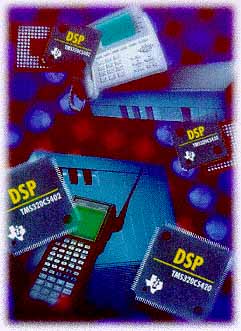 Two new power-efficient, ultra-small DSPs from Texas Instruments will help drive development of the next generation of cellular telephones, hand-held computers, personal digital assistants (PDAs) and dozens of other portable and telecommunications products. The TMS320C5420 offers 200 MIPS and the industry's lowest power rating, while the TMS320C5402 is the industry's lowest-cost solution at $5 per MIPS (in 50K quantities).