



In This Issue
Networking
Mixed-Signal and Analog
Business News
|
App Report
Acoustic-echo cancellation software for hands-free wireless systems: This note describes the DSP implementation of a full-duplex acoustic-echo cancellation (AEC) software. This software is based on the normalized least mean square (NLMS) algorithm. The algorithm includes active-channel and double-talk detection. This software was implemented on a TMS320C54x digital signal processor (DSP) in assembly language. It requires few resources in terms of million instructions per second (MIPS), random-access memory (RAM) and read-only memory (ROM). AEC achieves 30 dB of attenuation in an automobile environment. The NLMS algorithm cancels more or less echo depending on the noise level and responds well to variations of the signal level.
New safety regulations are leading the field of radio-communications toward hands-free radio/telephones. With such a system, the speaker (operator) can talk freely and still concentrate on his driving task. However, one of the drawbacks of this system is that acoustic echo is perceived by the far-end speaker. The European Telecommunication Standards Institute (ETSI) is currently specifying AEC systems.
The echo phenomenon is caused by the coupling between the loudspeaker and the microphone (See diagram below). In full-duplex communications, the far-end speaker hears his own voice with a delay (echo) depending on the automobile interior and the global system for mobile communications (GSM) delay. The length of the echo path is a key parameter for the AEC. The software described in this application note focuses on the automobile hands-free environment.
Adaptive filtering (and more precisely, the NLMS algorithm) is one of the most common solutions to the problems of AEC. The NLMS algorithm offers a good trade-off between computational load and performances. Other problems with AEC are double-talk (DT) conditions, where both operators are speaking at the same time. If not detected, DT can cause divergence of the adaptive algorithm. The AEC software utilizes the NLMS algorithm to cancel the echo and is implemented in 'C54x DSP assembler.
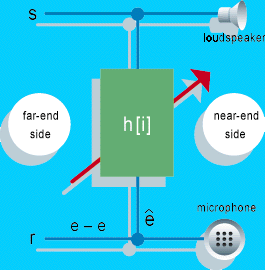 Overview of an AEC system The system includes the AEC software implemented on a TMS320C54x DSP, a loudspeaker and a microphone. For complete information, order: Application Report (SPRA162). See Order form
|