


 |
|
Special Focus on Logic Breaking the high-speed barrier ALVT: Migration from LVT LVC logic now specified to 1.8 V New bus switch keeps data moving LV CMOS redesigns provide faster speeds, lower power and lower noise New UBT optimized for high-performance backplane uses Industry cross-reference to TI low-voltage logic
|
ALVT: Migration from LVTDesigners who need higher performance than what LVT (Low-Voltage BiCMOS Technology) offers but do not want to sacrifice current drive and hot-insertion capabilities can turn to TI’s ALVT (Advanced Low-Voltage BiCMOS Technology) family of products. Operating at 3.3 V, ALVT devices already have been specified for 2.5-V operation for greater flexibility in future applications. The 5-V tolerant I/Os allow the devices to act as voltage translators. Featuring the latest 0.6-u BiCMOS tech-nology, ALVT products provide superior performance, delivering current drive of 64/-32 mA, stand-by current of 100 uA and maximum propagation delays of only 2.5 ns for buffers. The ALVT family features Auto 3-State, which prevents bus current loading when the voltage at the output is tied to a 5-V bus. Options such as bus-hold cells on the inputs eliminate the need for external pullup/pulldown resistors for floating inputs. Series Damping Resistors not only reduce overshoot and undershoot, but also help match the line impedance to minimize ringing. All of these features make ALVT products well suited for hot-insertion applications in areas such as networking and telecommunications. ALVT devices are available in space-saving packages, including shrink small-outline package (SSOP), thin shrink small-outline package (TSSOP) and thin very small-outline package (TVSOP). n For complete information, visit: Related Product Information.
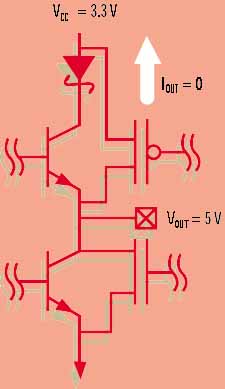 ALVT devices feature Auto 3-State, which elminates bus current loading when voltage at the output is tied to a 5-V bus. ALVT products All devices are specified for both 2.5-V and 3.3-V operation and all have Auto 3-State.
| ||||||||||||||||||||||||||||||||||||||||||||||||||||||||||||||||||||||||||||||||||||||||||||||||||||||||||||||||