


 |
|
Special Focus on Logic Breaking the high-speed barrier LVC logic now specified to 1.8 V New bus switch keeps data moving LV CMOS redesigns provide faster speeds, lower power and lower noise New UBT optimized for high-performance backplane uses Industry cross-reference to TI low-voltage logic
|
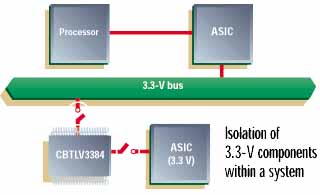
New bus switch keeps data moving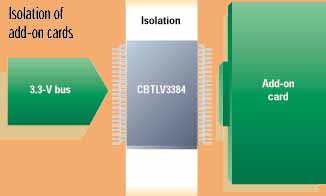 The latest addition to TI’s CBTLV family of low-voltage bus switches is the CBTLV3384, a device that provides 10 bits of high-speed bus switching. Like other members of its family, the CBTLV3384 features an extremely low propagation delay of only 250 ps for maximum throughput in high-speed systems. With digital electronics running at ever-higher clock rates, CBTLV bus switches remove barriers to system performance. High-speed microprocessors, synchronous DRAMs and new bus architectures all benefit from the CBTLV3384, keeping system data moving fast. TI bus switches bring greater speed and reduced power consumption to the design of high-end workstations, portable PCs, hard disk drives, industrial control systems and telecommunications equipment. A CBTLV switch consists of an n-channel MOS transistor in parallel with a p-channel MOS transistor. When the switch is open, it provides 3-state isolation for its bus line. When the switch is closed, it imposes a near-zero propagation delay on the line. The new CBTLV3384 is organized as dual 5-bit bus switches with separate output-enable (OE) inputs, so that it can be used as two 5-bit switches or a single 10-bit switch. All CBTLV products feature industry-standard pinouts and LVTTL-compatible I/O levels. n For complete information, order: CBTLV3384 Data Sheet (SCDS059B). See Related Product Information.
 |