|
Design Manual - PDF
Wireless Terms |
TMS320FLEX1 ChipsetPutting advanced wireless messaging within reach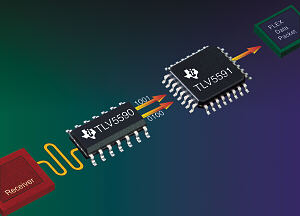 TMS320FLEX1 -- the new two-chip wireless messaging solution As the demand for wireless messaging continues to grow, service providers look for new ways of increasing service quality and subscribers, while OEMs seek access to technology that enables fast time-to-market with standard-compliant products. Now, a new two-chip solution from Texas Instruments is meeting these needs, making advanced wireless messaging applications a reality today. The TMS320FLEX1 chipset , which handles the A/D data conversion and decoding of FLEX™ wireless messaging transmissions, offers advantages over other messaging solutions with easy upgrade and redesign from existing systems, reduced system component count and lower system power consumption. As a TI Digital Signal Processing Solution, the TMS320FLEX1 chipset gives designers a seamless bridge of analog and digital system functions. Advantages of the FLEX Messaging Protocol The FLEX protocol offers significant improvements in messaging data integrity, transmission speeds, capacity and battery life. Beyond paging, this power and versatility will enable a spectrum of new applications that integrate wireless messaging functionality. The protocol, which is becoming the defacto standard worldwide, will enable high-quality, one-way wireless messaging that will drive the FLEX protocol into a range of diverse applications such as PCs, personal digital assistants (PDAs), smart home electronics and automobiles. FLEX enables increased system capacity with its provision for multi-speed communication. Systems providers using the protocol can select from three transmission speeds -- 1600 bps, 3200 bps and 6400 bps. Operating at full 6400 bps speed, FLEX systems deliver more than 10 times the performance of current 512 bps paging systems. FLEX can also coexist with older systems so that providers can continue service to current users as they upgrade to FLEX-based systems.
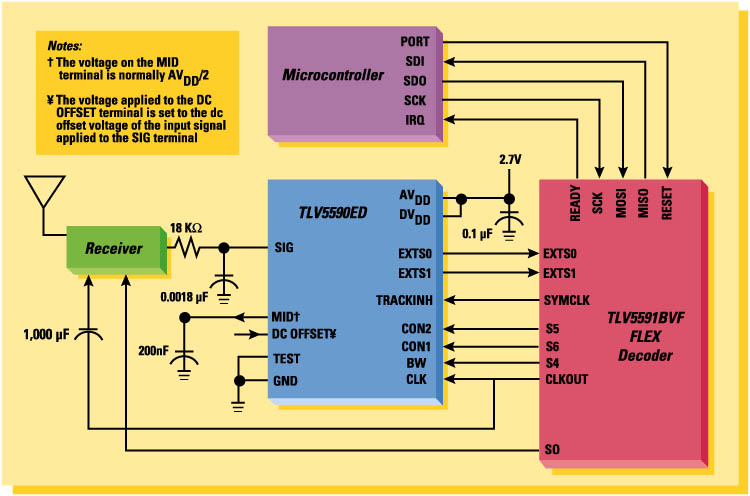
TMS320FLEX1 -- The Performance SolutionNow, designers can get the combined benefit of FLEX messaging in an integrated, cost-effective solution from Texas Instruments. The TMS320FLEX1 chipset was developed to simplify the implementation of the FLEX protocol, offering system designers, simple ease of upgrade from existing designs and reduced part counts with no required glue logic. Comprised of TI's industry-leading TLV5590 2-bit A/D converter and the TLV5591 FLEX decoder, TI's solution requires designers to add an existing microcontroller and receiver to get FLEX designs up and running quickly. This implementation not only reduces time-to-market but lowers system cost over alternative discrete solutions that require extensive and expensive hardware redesign.The TMS320FLEX1 chipset was designed in close conjunction with the developers of the FLEX protocol to maximize the operating efficiency of TMS320FLEX1-based wireless messaging systems. As a result, the chipset offers some important system-level benefits, including faster acquisition and synchronization of system data, less system on-time and longer battery life. Future FLEX developments will support two-way data and voice-and-data with the respective ReFLEX™ and InFLEXion™ protocols.
The ChipsetTLV5591 --The TLV5591 FLEX decoder is a highly optimized device that processes received and demodulated information from a FLEX transmission. The device is responsible for selecting messages addressed to the messaging device and communicating the message to the host. The TLV5591, which can operate in either 1600-, 3200- or 6400-bps modes, contributes to significant power savings by enabling the host microcontroller to operate in low power mode when message information is not being received.
Specifics of the TLV5591Decoder Include:
The TLV5590 2-bit A/D converter was developed specifically to optimize data conversion in messaging systems. In the TMS320FLEX1 implementation, it converts an audio signal from the receiver to a 2-bit digital output for processing by the TLV5591 FLEX decoder. The converter interfaces directly without any glue logic to the TLV5591, reducing part count and power consumption. Designed exclusively for FLEX messaging applications, the TLV5591 incorporates signal conditioning and peak and valley detection in addition to analog-to-digital conversion.
Specifics of the TLV5590 Device Include:
Software Development SupportWith the TMS320FLEX1 chipset, designers also have access to complete FLEXstack system software used to help build world-class products quickly and effectively. The software is specifically designed to support the TLV5591 FLEX decoder. It runs on the system's host processor and communicates with the decoder to interpret FLEX data-packets passed to the host from the decoder. FLEXstack software is available on the worldwide web at http://www.mot.com/FLEXstac. http://www.mot.com/FLEXstac.
The TMS320FLEX1 -- For a New Generation of Wireless MessagingThe TMS320FLEX1 chipset makes it possible for designers to create a new generation of powerful FLEX-based wireless messaging applications. Like the standard itself, the solution delivers the flexibility that allows manufacturers to quickly modify existing designs or develop exciting new applications with the volume and quality assurance of Digital Signal Processing Solutions from TI. |