|
Handsets Digital Baseband Analog Baseband Radio Frequency Power Management
Baseband Interface
Baseband Processors
|
Baseband Processors for Analog Cellular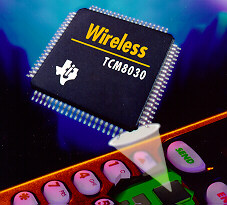 TCM8030 Baseband Processor for Analog Cellular Telephones
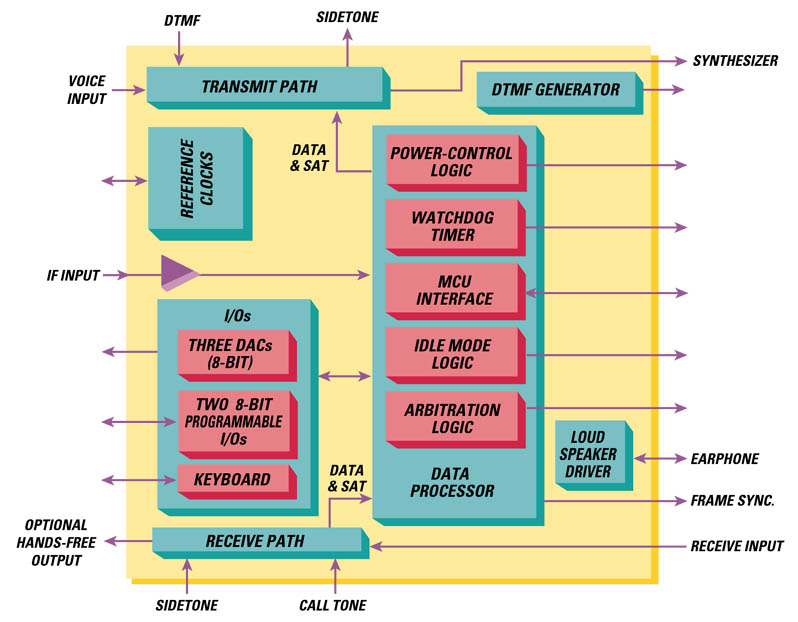
In the mature analog cellular market, TI's TCM8030 Baseband Processor for Analog Cellular Telephones is designed to help you maintain your competitive edge. This flexible, single-chip solution enables you to design analog and dual-mode analog and digital cellular phones that consume less power and can be priced competitively for end users. Because the TCM8030 is a complete solution, it handles all the audio and data processing required to support the full range of worldwide analog cellular standards, including the Advanced Mobile Phone System (AMPS), Total Access Communications System (TACS), Narrowband AMPS (NAMPS) and Narrowband TACS (NTACS).
TCM8030: the low-power solution

A complete analog baseband solutionThe TCM8030 uses a low-power mixed-signal CMOS process to integrate an entire analog baseband subsystem into a single 2.7 V to 5.5 V device. The completeness of the implementation gives you considerable design flexibility. With a simple, inexpensive microcontrol unit (MCU), you can design a low-cost, entry-level system, or you can add features in the MCU software and memory to create highly differentiated phones. And the TCM8030 helps keep design straightforward, since even in the most complex wireless handsets, the processor communicates with a wide range of MCUs through a simple, four-wire serial interface.Low power consumptionThe TCM8030 minimizes power consumption, extending talk and standby times, as well as giving you the option of designing your system to use smaller, lighter-weight batteries. The processor employs a variety of power-saving modes that allow the system to turn off most sections of the phone -- and of the device itself -- when they are not in use. For example, the TCM8030 monitors base station messages during idle modes, allowing the MCU to sleep while waiting for incoming calls.Reduced component countsA variety of on-chip functions reduce system component counts and expense. Among these functions are:
Low-profile packagingTo help you create smaller, more mobile systems, the TCM8030 comes packaged in an 80-pin thin quad flatpack (TQFP) that requires only 1.4 mm in vertical space. |
 Digital Signal Processing