


 In This Issue
DSP Solutions
Memory
Other Stories
Product Update |
Quicker RecallNew 64-Mbit SDRAMs now sampling
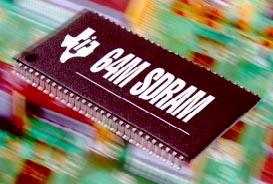
A new family of low-power, 64-megabit synchronous DRAM (SDRAM) memories are now available in sample quantities from TI. Designated the TMS664xxx family, the 3.3-V devices allow designers to improve system performance by increasing memory bandwidth, while keeping the system's physical size and power requirements to a minimum. Applications that can benefit include servers, work-stations and portable computers. TMS664xxx features
"As evidenced by Microsoft's PC'97 initiative, the trend in the industry is toward systems that require more memory and, at the same time, very high-speed memory," said Bob Harrison, TI's MOS memory marketing manager for the Americas. "Our TMS664xxx family of SDRAMs delivers on both counts. These devices can respond very quickly to data requests from the system's microprocessor, PCI bus, Advanced Graphics Port, Universal Serial Bus and 1394 peripheral bus." Fabricated with 0.3-micron CMOS technology, the TMS664xx family currently supports clock rates of 100, 83 and 66 MHz. Plans for second-generation devices call for speeds of up to 143 MHz. Designed for flexibility, the TMS664xxx devices are organized in four banks, each of which can be accessed individually or by interleaving. The memories are capable of either a 4K automatic refresh mode or a low-power self-refresh mode. The burst length of data reads can be programmed to one, two, four, eight or a full page of addresses; and read latencies can be set at two or three cycles. The devices also feature a high-speed, low-noise Low-Voltage TTL (LVTTL) interface. Samples of TMS664xxx memories are available in JEDEC-standard 400-mil, 54-pin thin small outline (TSOP) packages and 168-pin dual in-line memory modules (DIMMs). Volume production is scheduled for 3Q97.
|
