|
1394 Serial Bus Devices
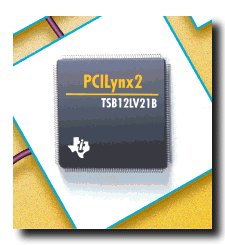
PCILynx2 - TSB12LV21B
Product DescriptionThe TSB12LV21B (PCILynx-2) provides a high-performance IEEE 1394-1995 interface with the capability to transfer data between the 1394 PHY-link interface, the PCI bus interface, and external devices connected to the local bus interface. The 1394 PHY-link interface provides the connection to the 1394 physical layer device and is supported by the on-board link layer controller (LLC). The LLC provides the control for transmitting and receiving 1394 packet data between the FIFO and PHY-link interface at rates of 100 Mbit/s, 200 Mbit/s, and 400 Mbit/s. The link layer also provides the capability to receive status from the physical layer device and to access the physical layer control and status registers by the application software. An internal 4K-byte memory is provided that can be configured as multiple variable-size FIFOs and eliminates the need for external FIFOs. Separate FIFOs are user configurable to support 1394 receive, asynchronous transmit, and isochronous transmit transfer operations. The DMA controller uses packet control list (PCL) data structures to control the transfer of data and allow the DMA to operate without host CPU intervention. These PCLs can reside in PCI memory or in memory that is connected to a local bus port. The PCLs implement an instruction set that allows linking, conditional branching, 1394 data transfer control, auxiliary support commands, and status reporting. Five DMA channels are provided to accommodate programmable data types. PCLs can be chained together to form a channel control program that can be developed to support each DMA channel. Data can be stored in either big endian or little endian format, eliminating the need for the host CPU to perform byte swapping. Data can be transferred to either 4- byte aligned locations to provide the highest performance, or to nonaligned locations to provide the best memory use.
Target Applications
For more information on the PCILynx2 - TSB12LV21B, please contact your local TI sales office |